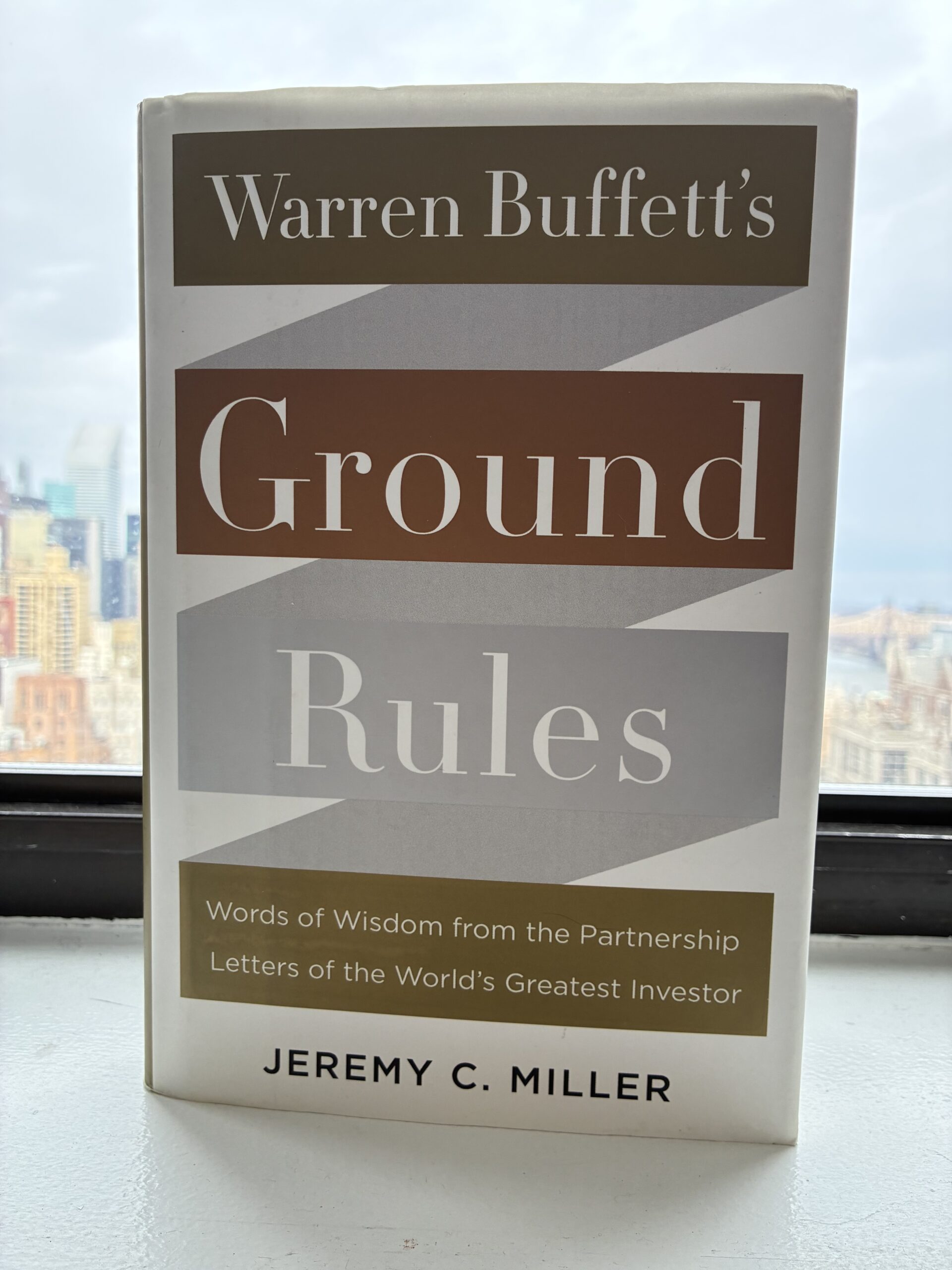
Warren Buffett’s Ground Rules
Jeremy Miller · Book Summary
The Buffett Partnership letters decoded. Twelve years of partner communications that reveal the rules, the temperament, and the specific methods behind one of the greatest investment track records ever compiled.
ℹ Disclosure: This post contains Amazon affiliate links. If you buy through them, we earn a small commission at no extra cost to you. We only link to books we’ve read and recommend.
Before Berkshire, there was the Buffett Partnership. From 1957 to 1969, Buffett compounded at 29.5% annually — against the Dow’s 7.4% — without a single losing year. Jeremy Miller has decoded the annual letters Buffett sent his partners into a coherent investment framework. The rules he followed then are the same rules that made Berkshire. They are also rules any serious investor can study and apply.
Overall rating
7.4/10
The most specific account of how Buffett actually thought and invested during his formative years. Narrower than the other Buffett books, but more practically precise.
The Buffett most investors have never studied.
Buffett wound down the Partnership in 1969, not because it was failing but because he believed the market had become too speculative and he could no longer find the bargains that his method required. He returned all capital to his partners with full explanations. The decision itself is a lesson in intellectual honesty.
Most investors who study Warren Buffett study Berkshire Hathaway — the conglomerate he has run since 1965. But Berkshire Buffett operates under different constraints than partnership Buffett did. He manages too much capital to take the positions that generated the partnership’s extraordinary returns. The investment style that produced 29.5% annual returns for twelve years is not the style that currently operates Berkshire.
Warren Buffett’s Ground Rules is not a biography of Buffett. It is Jeremy Miller’s careful, systematic decoding of the annual letters Buffett wrote to his limited partners between 1957 and 1969. Those letters are publicly available, but Miller has organized them thematically rather than chronologically — extracting the investment principles, the performance philosophy, and the specific methods that Buffett employed during the most replicable period of his career.
The result is the closest thing that exists to a written manual for the investment approach that made Buffett’s early track record. For investors interested in value investing specifically — in buying businesses at significant discounts to intrinsic value and waiting — this book is more practically useful than the Berkshire shareholder letters, because the approach it describes is one a smaller investor can actually employ.
Twelve years. 29.5% annually. Not a single losing year.
The partnership’s fee structure was itself a statement of alignment. Buffett charged no management fee at all. He took 25% of profits above a 6% annual hurdle rate — and he personally funded any underperformance below that hurdle in future years. His compensation was entirely performance-dependent. This structure is virtually unheard of in modern fund management.
The Buffett Partnership ran from 1957 to 1969. In twelve years of operation, it never had a losing year. Its worst year was 1962, when the Dow fell 7.6% and the partnership returned 13.9%. Its best year was 1968, when it returned 58.8% against the Dow’s 7.7%. The compound annual return over the full period was 29.5%, against the Dow’s 7.4%. A $10,000 investment in 1957 became $150,270 by 1969 through the partnership, versus $19,000 through the Dow.
The chart below shows the year-by-year comparison. Toggle between cumulative and annual views to see both the consistency and the magnitude of the outperformance.
Toggle between cumulative growth and annual returns to see the full picture of the partnership’s track record.
The seven principles Buffett set for himself — and his partners
At the start of each partnership, Buffett distributed a set of ground rules to his limited partners. These were not investment tips — they were the terms of engagement. They explained how he thought, what he would and would not do, and how he expected his partners to evaluate his performance. Miller’s book unpacks each rule in detail. The rules collectively describe an investment philosophy that is as coherent today as it was in 1957.
How Buffett actually found and structured his positions
Buffett’s “generals” category was essentially classic Graham-style deep value investing — buying statistically cheap stocks without a specific catalyst. He later moved away from this approach under Munger’s influence, shifting toward buying excellent businesses at fair prices. The partnership letters document this evolution in real time.
Generals — Undervalued securities
The largest category by capital deployed. Generals were stocks that Buffett believed were trading at a significant discount to their intrinsic value, with no specific near-term catalyst. He would buy a significant position, then wait for the market to recognize the value. These positions could take years to resolve. He typically owned 5–10 generals at any given time and concentrated capital in his highest-conviction ideas.
Workouts — Special situations
Buffett’s workout positions were explicitly designed to be uncorrelated with the market. He could predict the outcome of a merger or liquidation event without needing to predict what the Dow would do. This was a deliberate structural choice — not all the eggs in the same macro basket.
Workouts were positions tied to corporate events — mergers, acquisitions, spin-offs, or liquidations — where the return was determined by a predictable corporate action rather than market sentiment. The outcome was knowable within a reasonably defined time frame. Workouts provided more predictable returns and, importantly, were largely uncorrelated with general market movements. They acted as a ballast during market downturns, which is part of why the partnership never had a losing year.
Controls — Majority ownership positions
The smallest but most capital-intensive category. Controls were positions where Buffett had accumulated enough shares to influence or control corporate decisions — board composition, dividend policy, capital allocation. Sanborn Map Company was an early example. Berkshire Hathaway itself began as a control position in the partnership before being spun out separately. Controls took years to resolve and required active involvement in management decisions.
What the book delivers, and what it cannot
Miller is a value investor himself, and his framing is sympathetic throughout. The book does not seriously engage with the possibility that Buffett’s partnership returns reflect a combination of genuine skill and a specific market environment — the post-war era when institutional investors were less sophisticated and the market was genuinely less efficient than it is today.
The context problem: a less efficient market
Buffett’s partnership operated in a market environment that was materially less efficient than today’s. Institutional investors were less numerous and less sophisticated. Information was harder to obtain and slower to travel. The statistical bargains that powered his generals category — stocks trading at a discount to net cash — were far more common in the 1950s and 1960s than they are in an era of algorithmic screening and global information flow. The framework is sound; whether it can generate similar returns in today’s market is a harder question that the book does not fully address.
The concentration question
Buffett’s concentration philosophy — putting a large portion of capital into a handful of highest-conviction ideas — is the aspect of his approach most at odds with conventional portfolio theory. It produced extraordinary returns in the partnership. It also requires extraordinary conviction, extraordinary research depth, and tolerance for significant short-term volatility that most investors do not actually have when the position is down.
One of the book’s most challenging implications is Buffett’s concentration approach — putting significant capital into a small number of high-conviction ideas rather than diversifying across many positions. The partnership’s returns required concentration. But concentration that works looks identical to concentration that fails until after the fact. The book correctly describes what Buffett did without fully grappling with how retail investors can know when their conviction is warranted.
Miller’s contribution is real but narrow
Warren Buffett’s Ground Rules fills a genuine gap — the partnership letters exist, but reading them chronologically without context is less useful than Miller’s thematic organization. His annotations and explanations add real value for investors who want to study Buffett’s early methods seriously. The book’s weakness is its scope: it covers the partnership period specifically, and readers who want the fuller arc of Buffett’s intellectual development will need the Berkshire letters as well.
The Wealth Shelf take on reading this book
Read this alongside The Intelligent Investor, not instead of it. Graham’s book provides the theoretical foundation; Miller’s book shows what that foundation looks like in practice during one of the most successful implementations in investing history. The sections on how Buffett measured performance, structured his partnership, and thought about risk are the most broadly applicable. The specific stock-picking methods require more skepticism about whether they translate to a modern, more efficient market environment.
Three things the book makes immediately applicable
1. Adopt Buffett’s performance measurement standard
Buffett did not measure his performance in absolute terms. He measured it relative to what the Dow did in the same year. A 15% return in a year when the market returned 20% was, by his standard, a failure. A 0% return in a year when the market fell 20% was a success. Most investors track their returns without ever asking the only question that matters: how did I do compared to the index I would have owned if I had simply bought it? The comparison is uncomfortable. It is also the only honest benchmark.
2. Apply the ground rules to your own investment process
Ground Rule 5 is the one most investors violate most often: Buffett explicitly told his partners not to expect to beat the market in every year, and not to judge the partnership’s performance in any single year. He asked to be judged over a minimum of three years, and preferably through a full market cycle. Most investors and their advisors are evaluated quarterly.
Buffett’s ground rules were a commitment device — written principles that made it harder to deviate from a disciplined process when market conditions created pressure to do so. Writing out your own investing ground rules — what you will and will not do, how you will measure yourself, what your time horizon is, how you will handle a 30% drawdown — is not a bureaucratic exercise. It is the difference between a plan and a set of intentions, and it matters most precisely when markets make discipline hardest.
3. Separate the framework from the era
The most useful thing to take from this book is not Buffett’s specific methods but his mental framework: the requirement to understand what you own, the emphasis on downside protection before upside, the insistence on measuring results honestly against the relevant benchmark, and the willingness to hold cash when acceptable opportunities are not available. These are transferable. The specific bargain stocks of the 1950s and 1960s are not — but their modern equivalents, in form if not in abundance, still exist for investors willing to look where others are not.
Where to go after Warren Buffett’s Ground Rules
The most precise account of how Buffett actually thought before scale made his methods unavailable.
Warren Buffett’s Ground Rules is not for every investor. It is for investors who are seriously interested in value investing — in understanding not just what Buffett did but why, and what principles underlay a twelve-year track record that has never been replicated at that consistency and magnitude.
Miller’s organization of the partnership letters is genuinely useful. The thematic structure — performance philosophy, investment categories, concentration versus diversification, the ground rules themselves — makes the letters more accessible and more practically applicable than reading them in sequence. For value-oriented investors, this book fills a gap that no other Buffett text does.
Read next in the library: The Intelligent Investor — Graham is the theoretical foundation on which Buffett built everything. The partnership methods only make full sense in the context of Graham’s framework. Reading them in sequence — Graham first, Miller second — is the most coherent way to understand where these ideas came from and how they were applied. →
Buy Warren Buffett’s Ground Rules on Amazon →