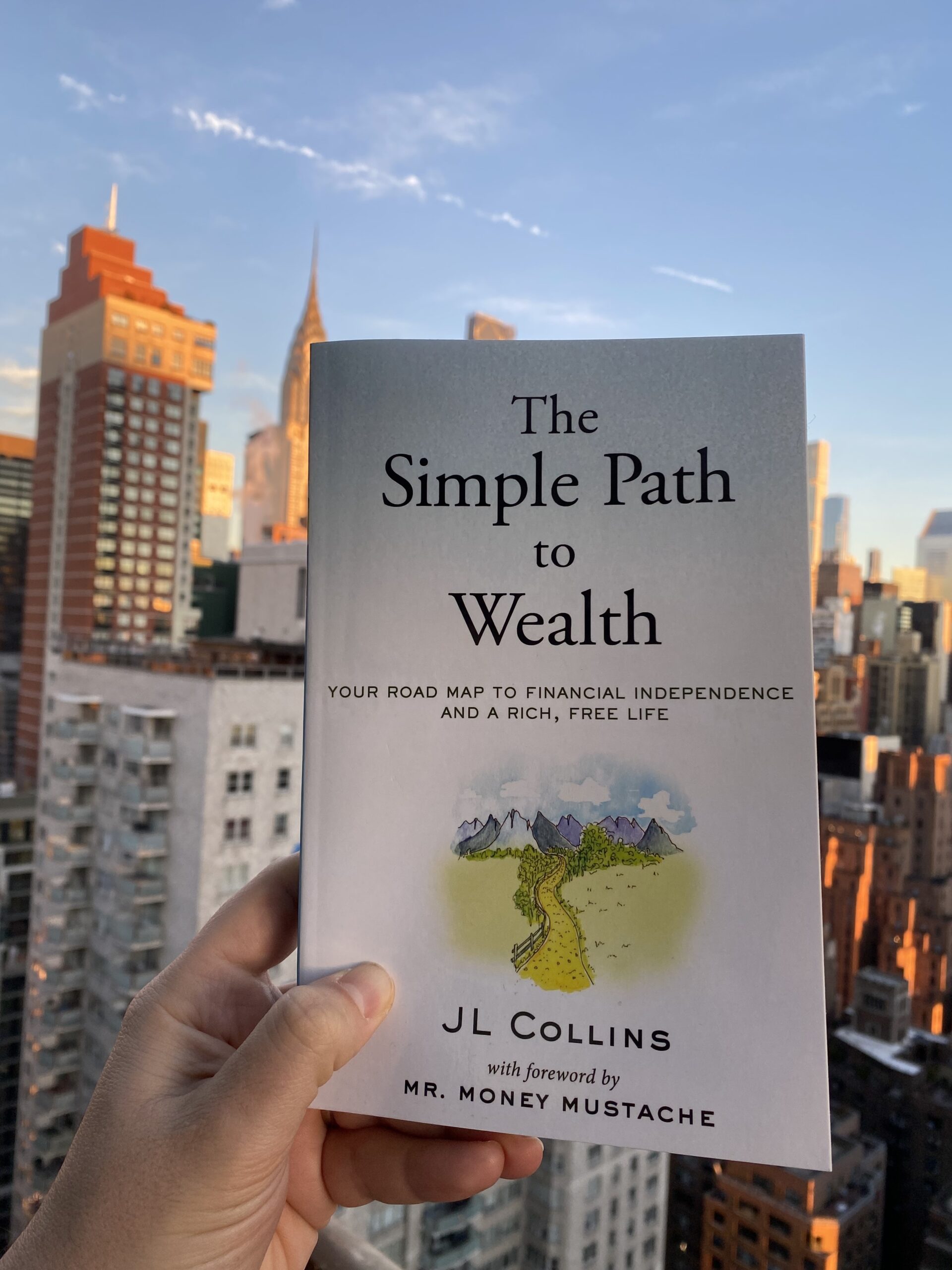
The Simple Path to Wealth
JL Collins · Book Summary
Collins wrote this as a series of letters to his daughter. The core message: own one fund, keep costs near zero, never stop contributing, and ignore almost everything else. It is the clearest distillation of index investing ever written.
ⓘ Disclosure: This post contains Amazon affiliate links. If you buy through them, we earn a small commission at no extra cost to you. We only link to books we’ve read and recommend.
Debt is a crisis. F-you money is freedom. Invest in one low-cost total market index fund — VTSAX or equivalent — and never stop. The market always recovers. Complexity is not sophistication; it is a cost. Financial independence is not about retiring early or being rich. It is about having enough choices that work stops being mandatory.
Overall rating
8.0/10
The most complete single-book case for index investing ever written. Opinionated, clear, and honest — including about what it cannot do for you.
Complexity is a product being sold to you. Simplicity is the strategy.
Collins started writing this as letters to his daughter when she showed no interest in managing money. The lack of jargon is intentional — he had to explain it clearly enough that someone who didn’t care would still act on it.
Collins’s central argument is both simple and radical: the financial industry profits from complexity, and the antidote is not finding a better financial product — it is rejecting the premise that you need one. Most investors would be better served by a single low-cost total market index fund than by any actively managed portfolio, any financial adviser’s recommendations, or any attempt to time or beat the market.
The evidence behind this argument is not Collins’s own — it is Bogle’s, and Buffett’s, and decades of fund performance data. Collins’s contribution is translating that evidence into a prescription simple enough to follow and clear enough to trust. His message: you do not need to understand complex financial instruments, predict economic cycles, or pick individual securities. You need to own the whole market at near-zero cost, contribute consistently, and hold long enough for compounding to work.
The book is built around three stages of financial life, two types of market behavior, and one fund. The framework is deliberately stripped of optionality. Collins is not trying to give you choices — he is trying to remove the need for them.
F-you money — Collins’s most important concept
Collins is deliberate about the language. “F-you money” is not about being rude — it is about having enough financial independence that no single employer, relationship, or circumstance can trap you. The word choice makes the concept memorable in a way that “emergency fund” never does.
Before investing, Collins argues you need f-you money. Not retirement savings, not an investment portfolio — a pool of liquid capital large enough to give you genuine options. Enough to quit a job you hate. Enough to walk away from a bad situation. Enough to say no to things that compromise your integrity or your time.
The concept predates the FIRE movement but anticipates it exactly. F-you money is not about accumulating a specific number — it is about the threshold at which financial pressure stops driving your decisions. For most people, that threshold is lower than they think. Three to six months of expenses in a high-yield account is not f-you money. One to three years of expenses, in a stable fund, invested and growing, starts to become it.
The key distinction Collins draws
F-you money is not retirement. Retirement is a number you reach and stop at. F-you money is a posture — a financial position that changes how you operate in every professional and personal relationship. Collins argues this matters more than the specific number, because the psychological shift it creates happens before you reach full financial independence.
Where you are determines what you do
Collins organises his investment advice around three stages of financial life. The stage you are in determines your asset allocation, your approach to debt, and your relationship with market volatility. Most personal finance books ignore this structure entirely — they give universal advice that is wrong for two out of three stages.
Wealth Accumulation
Wealth Preservation
Wealth Distribution
Bull markets and bear markets are both good — if you understand them
Collins’s most important behavioral contribution is reframing market volatility as a feature rather than a threat. Whether you should welcome or fear a market drop depends entirely on which stage you are in — and most investors never make this distinction.
Select your stage to see how Collins says you should think about each market condition.
Accumulating + Bull Market
Your portfolio is growing. Each contribution buys shares at higher prices than before, which means your compounding base is expanding. Returns are strong and motivation is easy. The risk in this phase is complacency — assuming bull markets are the default and panicking when they inevitably end.
“Enjoy the ride. It won’t last. But it doesn’t have to — the bear market will be your friend when it arrives.”
Why one fund beats almost every alternative
Collins’s VTSAX recommendation is Vanguard-specific. The principle — own a total US market index fund at the lowest possible cost — applies to any broker. Fidelity’s FZROX (0% expense ratio) and Schwab’s SWTSX (0.03%) are functionally identical strategies.
Collins’s fund recommendation is VTSAX — Vanguard Total Stock Market Index Fund — or its ETF equivalent, VTI. His reasoning is straightforward: the fund owns a tiny slice of every publicly traded company in the United States, weighted by market capitalisation. When you buy it, you own American business in proportion to its size. You are not betting on any sector, any company, or any economic forecast. You are betting that American business will be worth more in twenty years than it is today.
The historical case for this bet is strong. Over any 20-year period in US market history, a total market index fund has never produced a negative return. The cost advantage compounds the return advantage: a 0.04% expense ratio versus the 1–1.5% charged by a typical actively managed fund is not a small difference over decades — it is the difference between retiring at 55 and retiring at 65 for many investors.
| Fund | Ticker | Expense Ratio | Covers |
|---|---|---|---|
| Vanguard Total Stock Market Collins’s primary recommendation |
VTSAX / VTI | 0.03–0.04% | ~3,700 US stocks |
| Fidelity Zero Total Market Best for Fidelity accounts |
FZROX | 0.00% | ~2,700 US stocks |
| Schwab Total Stock Market Best for Schwab accounts |
SWTSX | 0.03% | ~2,500 US stocks |
| Vanguard Total Bond Market Collins’s Stage 2/3 addition |
VBTLX / BND | 0.05% | ~10,000 US bonds |
Collins’s position is unambiguous
Collins’s view on mortgages is more nuanced than his view on consumer debt. A mortgage on a home you can genuinely afford — where the payment leaves room for investing — is not the same as credit card debt. The key question: does the debt enable wealth building or impede it?
Collins treats debt as a wealth emergency. Not a challenge to manage or a tool to leverage — an emergency requiring immediate resolution. His reasoning is mathematical: paying off 20% APR credit card debt is a guaranteed 20% return. No investment reliably beats it. Every month you carry high-interest debt is a month your investment returns are being consumed by interest payments.
His prescription: eliminate all high-interest consumer debt before investing beyond employer match. The sequence matters. A 401(k) employer match is a guaranteed 50–100% return and takes priority over everything. After that, high-interest debt elimination comes before any other investment. The order is not flexible.
What the book gets right and where it has limits
The US-only critique is the most substantive one. A total US market fund means 100% domestic equity exposure. International diversification — which Collins dismisses in a few paragraphs — has genuine academic support and several decades of evidence behind it.
The case for simplicity is real and evidence-based
The core argument — that low-cost index funds outperform actively managed alternatives over long time horizons, and that simplicity reduces the behavioral errors that destroy investor returns — is not a contrarian view. It is the mainstream position of academic finance and has been validated repeatedly over 40+ years of fund data. Collins is not making a novel argument; he is making it better than almost anyone else.
The US-only limitation is real
Collins’s recommendation is VTSAX — a US total market fund. His dismissal of international diversification is the book’s most contestable claim. The US has been the world’s dominant equity market for the past century, but there is no guarantee this continues. Investors who followed a US-only strategy from 2000 to 2010 experienced a lost decade while international markets delivered positive returns. A more defensible position includes some international exposure, though Collins’s simplicity argument remains compelling for investors who will actually follow it versus a theoretically superior strategy they won’t.
What cannot be faulted
The behavioral insight that complexity increases the probability of bad decisions — panic selling, market timing, chasing performance — is correct and under-acknowledged in finance. Collins’s prescription for what most investors should do with most of their money is right. The implementation gap between knowing the right strategy and following it through market crashes is exactly where his book does its most important work.
The Wealth Shelf take on reading this book
Read this before you open any investment account. Collins removes every excuse for not starting and every reason to overcomplicate what you do once you have. The US-only limitation is worth being aware of, but it does not undermine the core case. For the majority of investors — especially those in their 20s and 30s building wealth from a standing start — this book contains everything they need to get the decision right.
Where to go after The Simple Path to Wealth
The clearest investment book ever written. Possibly the only one most people need.
The Simple Path to Wealth scores an 8.0 because the core argument is correct, the evidence is solid, the writing is clear, and the behavioral insight — that simplicity is not a compromise but a strategy — is more valuable than most of what passes for financial sophistication. The US-only limitation and the light treatment of international diversification are real gaps, but they do not undermine the prescription for the vast majority of its readers.
If you read only one book on investing, this is the one. If you read more, start here and let Collins set the standard for what clarity and evidence actually look like in personal finance writing.
Read next in the library: The Little Book of Common Sense Investing — Bogle’s empirical case provides the data behind every claim Collins makes. The two books together are unassailable. →
Buy The Simple Path to Wealth on Amazon →