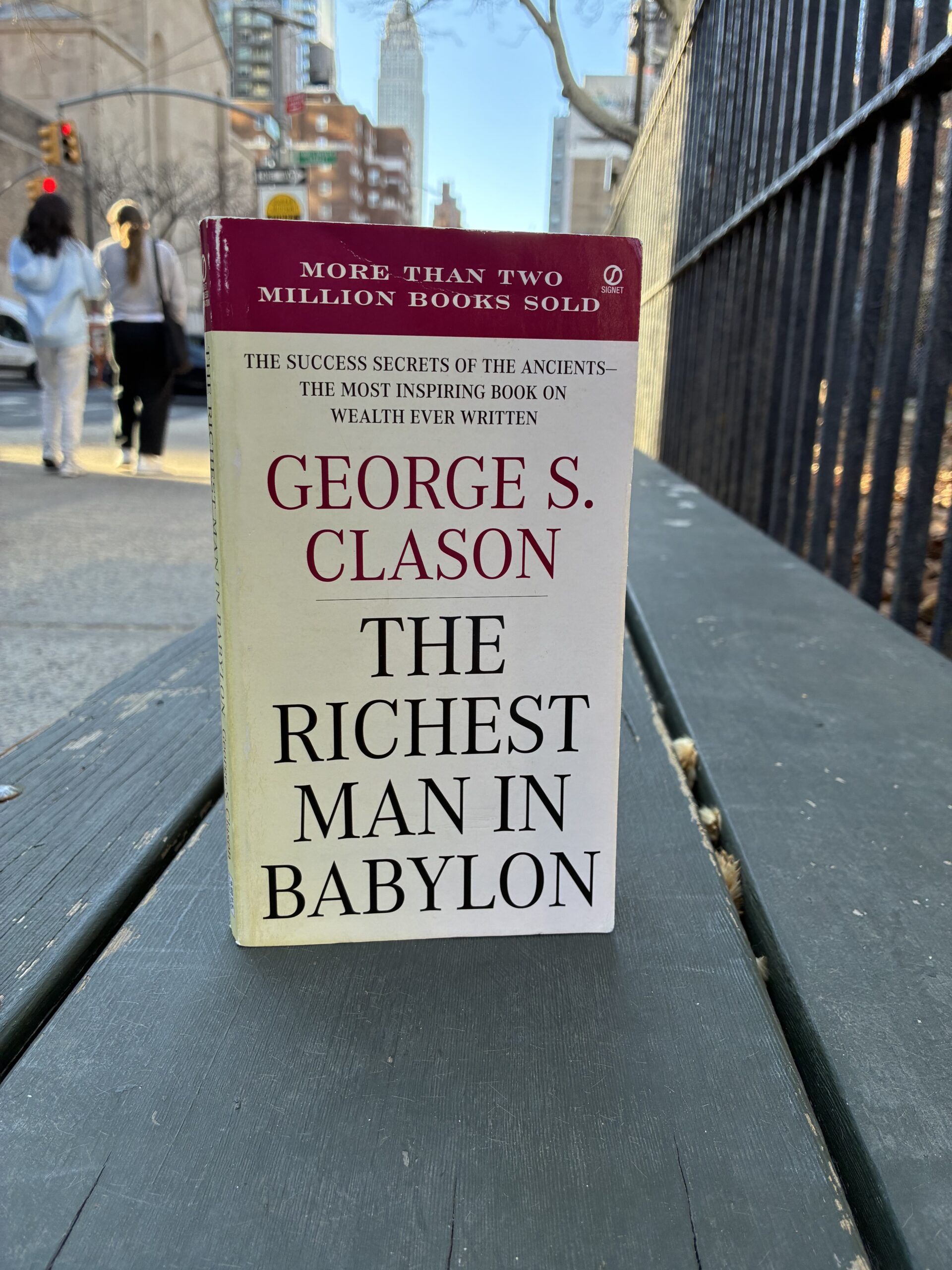
The Richest Man in Babylon
George S. Clason · Book Summary
Written in 1926. Set in ancient Babylon. The principles are unchanged. Nearly a century of readers have found the same thing: the rules are simple, the execution is the whole challenge.
ℹ Disclosure: This post contains Amazon affiliate links. If you buy through them, we earn a small commission at no extra cost to you. We only link to books we’ve read and recommend.
A man who earns ten coins and spends ten coins will never build wealth. A man who earns ten coins and keeps one has started. Clason wrote this as fiction set in ancient Babylon. The rules he gave his characters are the same rules that build wealth today. The gap between knowing them and following them is the only thing that has ever stood in the way.
Nearly 100 years old and still the clearest statement of the principles that build wealth. The evidence is fiction. The rules are real.
The seven cures and five laws are among the clearest prescriptions in personal finance literature. Simple enough to remember, specific enough to act on immediately.
The book is fiction. Parables set in ancient Babylon are not data. Clason makes no empirical claims and offers no research. The principles are correct — but the evidence for them comes from everywhere except this book.
Written as a series of short stories. The faux-ancient prose is occasionally jarring but the ideas are clearer than almost any other personal finance book. Readable in a single afternoon.
The principles are so well known that they no longer feel contrarian. Pay yourself first, live below your means, let money work for you — everyone has heard these. The book’s value is in making them feel urgent again.
First published in 1926. Based on principles the author attributes to civilizations thousands of years older. The rules have not changed. They will not change. This is as close to a permanent book as personal finance produces.
The rules that build wealth have not changed in 4,000 years
Clason originally wrote these stories as pamphlets distributed by banks and insurance companies in the 1920s. They were collected into a book in 1926. It has never gone out of print.
George Clason published The Richest Man in Babylon in 1926 as a collection of parables set in ancient Mesopotamia. The central character is Arkad — a man born poor who becomes the wealthiest man in Babylon by following a set of principles so simple they can be summarized in a sentence: spend less than you earn, save the difference, and put the savings to work.
The book has sold tens of millions of copies across nearly a century. It has been recommended by financial advisors, passed between generations of the same family, and cited by investors who have since built serious wealth. Its longevity is not an accident. The principles it teaches are not a product of their time — they are a description of how wealth accumulation works mechanically, expressed through stories simple enough to remember and specific enough to act on.
The honest caveat up front: this is a book of fiction, not finance. Clason cites no data, presents no research, and makes no empirical claims. The evidence for his principles comes from everywhere except this book. What the book does exceptionally well is make the principles feel urgent and personal in a way that data rarely does. That is its genuine contribution.
Arkad’s complete framework — in plain language
Arkad teaches these principles to a class of men selected by the King of Babylon to learn wealth-building. The framing is simple: if one man can become the richest in Babylon starting from nothing, the principles he used are learnable.
The seven cures are the structural core of the book. They appear in the second section, delivered as a series of lectures by Arkad to men chosen by the king to learn how to build wealth. They are sequential — each one builds on the last. The first cure is the foundation without which none of the others function.
Start thy purse to fattening
Keep one coin in ten for yourself. Every time money comes in, the first tenth belongs to you — not your landlord, not your grocer, not anyone else. This is the foundation of everything. Without it, every other principle is irrelevant.
Control thy expenditures
Your necessary expenses will always expand to fill whatever you earn unless you consciously limit them. The gap between what you earn and what you spend is the only source of wealth. Desire and necessity are not the same thing.
Make thy gold multiply
Money kept idle builds nothing. Every coin saved should be put to work — invested in something that generates a return. Clason calls this making your gold breed gold. Compounding is the mechanism. Time is the ingredient.
Guard thy treasures from loss
The first goal of any investment is the return of your principal, not the return on it. Clason’s advice: consult people who know, not people who merely want your money. The desire for large returns clouds judgment. Protecting what you have built is as important as building it.
Make of thy dwelling a profitable investment
Own where you live if you can. A home eliminates rent as an expense and builds equity over time. Clason framed this as a man’s castle — a place where the money that would have gone to a landlord stays within the family instead.
Insure a future income
Build for the day you can no longer work — or choose not to. Clason wrote this for an ancient civilization with no pension system or social safety net. The principle is unchanged: the time to build future income is while you still have current income.
Increase thy ability to earn
The tenth coin you keep grows with your income. Investing in your own skills, knowledge, and capability increases the size of the base from which the tenth is taken. Learning to earn more is as important as learning to keep what you earn.
What the first cure actually looks like
Clason’s exact words: ‘A part of all you earn is yours to keep.’ The emphasis is on ‘yours.’ Every other payment you make — rent, food, taxes — is payment to someone else. The tenth coin is the first payment you make to yourself.
The first cure is the one that matters most and the one that most people never implement. Not because it is complicated — it is the simplest rule in the book — but because it requires a decision that runs against every instinct to spend what arrives. The tool below applies Clason’s rule to your actual income so the number is no longer abstract.
Arkad’s rule: keep one coin in ten for yourself, before any other obligation is paid. Enter your income below and see what that looks like — and what it compounds into.
Your income
Per
Arkad’s 10% — what it looks like
Per week
$96
Per month
$500
Per year
$6,000
If you invest it at 7% annual return
Clason called this “making your gold work for you.” This is what that looks like.
After 5 years
$35,519
After 10 years
$86,924
After 20 years
$260,773
Arkad would approve.
The first step is the decision. The second is the automation. Set up a standing transfer for $500 on the day your income arrives — before anything else is paid.
Projections assume monthly contributions of 10% of your stated income, invested at 7% annual return. For illustration only.
The second framework — how money behaves once you have it
The five laws appear in a story within the story — a father’s letter to his son, carried across the desert, explaining what he has learned about gold over a lifetime.
The seven cures tell you how to accumulate money. The five laws of gold tell you how money behaves once you have it — and what happens when you violate the rules. They are less prescriptive than the cures and more like observations about the nature of wealth.
The five laws, condensed
Gold comes to those who save at least a tenth of their earnings
The same as the first cure, restated as a law. Consistent saving is the only reliable source of accumulated capital.
Gold labors diligently for those who put it to work
Idle money builds nothing. Invested money compounds. The difference over decades is not marginal.
Gold clings to those who invest under wise counsel
Seek advice from people whose knowledge is demonstrated, not from people whose interest is your money. The two are usually not the same person.
Gold slips away from those who invest in unfamiliar things
Confidence in a sector or idea you do not understand is not a strategy. It is a transfer of your savings to someone who understands it better.
Gold flees the man who forces it into impossible earnings
High promised returns are usually high risk in disguise. The desire for fast growth is the most reliable predictor of catastrophic loss.
What the book does well and where it falls short
The evidence quality score of 4 reflects a deliberate judgment: fiction is not data. The principles are correct — but Clason offers no proof of that beyond the stories themselves. The proof comes from everywhere else in the library.
What it does exceptionally well
No personal finance book makes its principles more memorable than this one. The parable format, the named characters, the specific scenarios — Arkad lending money to a friend who loses it on bad advice, a young man squandering his inheritance — create anchors that stick in a way that bullet points do not. Readers who absorbed the seven cures at twenty often report that the framework stayed with them for decades. That is a rare pedagogical achievement.
The gold lender chapters — where Clason discusses lending at interest — require significant updating for a modern context. The mechanics of credit in ancient Babylon bear little resemblance to how debt works today.
Where it falls short
The second half of the book is weaker than the first. The chapters on gold lending, the camel trader, and the clay tablets introduce new characters and scenarios that add length without adding principles. The core framework is complete by the end of the seven cures section. Everything after that is reinforcement with diminishing returns.
The evidence quality is zero by modern standards. Clason makes no empirical claims and offers no data. The principles feel true because they are structurally sound — but readers who want the empirical case for pay yourself first and compounding should read Bogle, Stanley and Danko, or Collins alongside this book, not instead of it.
Read the first half carefully — the seven cures and the five laws. The parables work. The principles stick. If the faux-ancient prose feels labored, the modern editions with updated language are perfectly adequate. Do not expect data or nuance. Expect clarity. For a book that can be finished in two hours and remembered for twenty years, that is a more than acceptable trade.
Three things the book makes immediately actionable
1. Implement the tenth coin this week
Use the tool above to calculate your exact number. Then open a separate savings or investment account — if you do not already have one — and set up an automatic transfer for that amount on the day your income arrives. Before rent. Before groceries. Before any other obligation. The sequence is the point. Clason is explicit: pay yourself first means first, not last.
2. Audit the gap between desire and necessity
Clason writes that a man’s necessary expenses will always grow to meet his income unless he draws a clear line between what he needs and what he wants. Drawing that line is the second cure made practical.
The second cure asks you to distinguish between necessary expenses and desires. This is harder than it sounds because desires dressed as necessities are the primary mechanism by which savings disappear. A practical exercise: list every monthly expense and mark each one as either necessary or chosen. The chosen category is where the second tenth lives — and where the first tenth gets crowded out if you are not watching.
3. Do not invest in what you do not understand
The fourth law of gold is the most commonly violated principle in the book. The pattern is consistent: a promising opportunity, a confident presenter, a sense of urgency, money committed to something the investor cannot explain. Clason’s prescription is blunt — consult those whose knowledge of the thing is demonstrated by their own success with it. If you cannot find such a person, do not invest. Index funds exist precisely because most people cannot find such a person in public equity markets.
Where to go next
Clason tells you the rules. Housel explains why following them is harder than it sounds — and why behavior matters more than knowledge when it comes to actually building wealth.
Buy on Amazon →The data behind Clason’s parables. Stanley and Danko surveyed 1,000 real millionaires and found that the people who actually build wealth behave almost exactly the way Arkad prescribes.
Buy on Amazon →The modern implementation of Clason’s principles. Once you have committed to paying yourself first, Collins tells you exactly where to put the money and how to leave it alone.
Buy on Amazon →Nearly a century old. Still the clearest statement of the basics.
The Richest Man in Babylon is not a sophisticated book. It does not need to be. The principles it teaches are not sophisticated principles — they are foundational ones, and the reason they need restating every generation is that every generation finds new ways to avoid following them.
If you are early in your financial life, read this first. If you are further along and have not built the savings habit, read it anyway. The parable format makes the principles easier to remember than any data-driven book on the same subject. And remembering the principles is only useful if you then act on them.
Read next in the library: The Psychology of Money — Housel explains why following Clason’s rules is harder than they sound, and what the people who actually follow them have in common. →