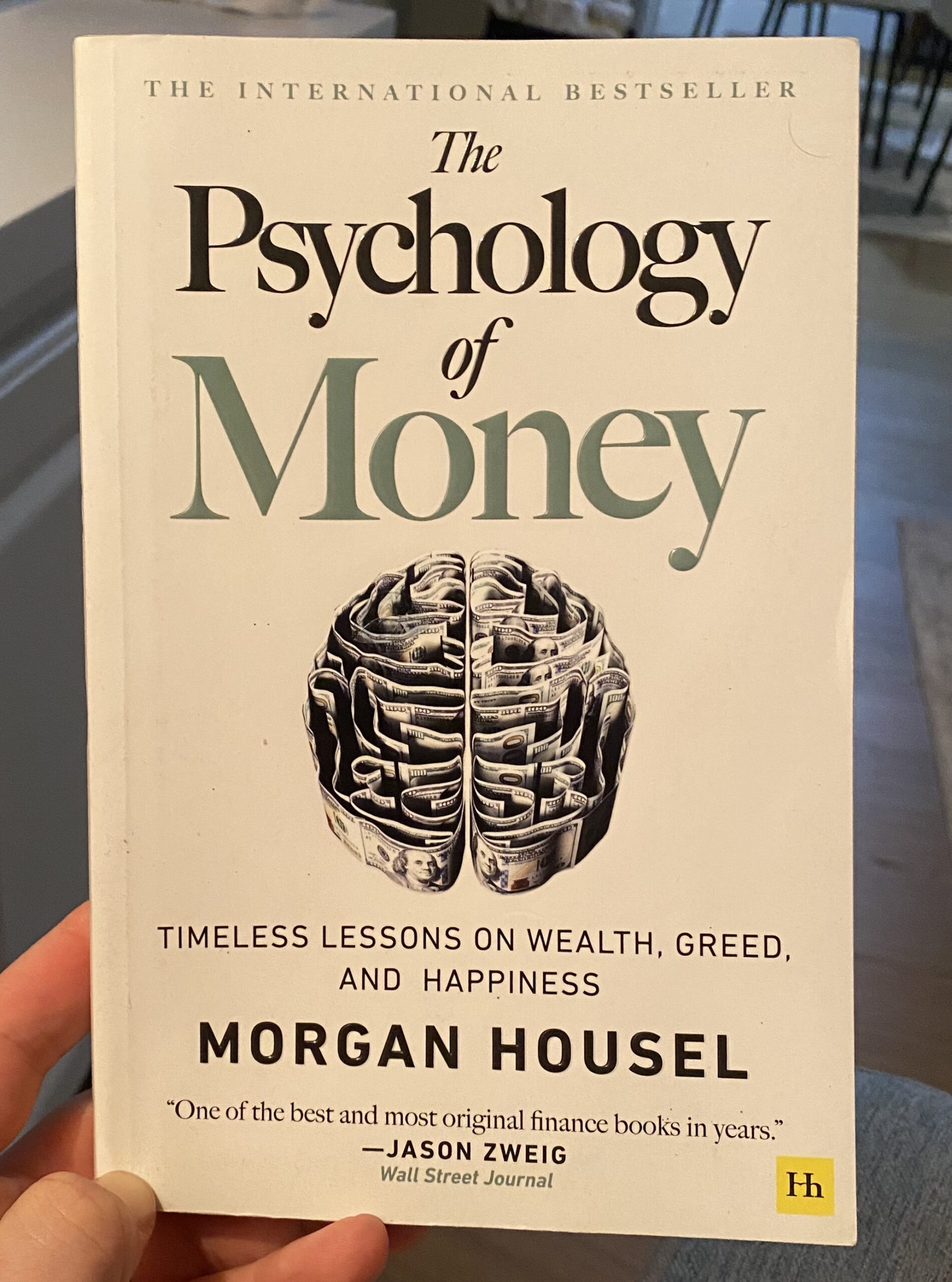
The Psychology of Money
Morgan Housel · Book Summary
No finance book published in the last decade has done more to change how people actually behave with money. Housel’s argument — that behaviour matters more than knowledge — is both obvious and almost entirely absent from personal finance education.
ⓘ Disclosure: This post contains Amazon affiliate links. If you buy through them, we earn a small commission at no extra cost to you. We only link to books we’ve read and recommend.
Doing well with money has little to do with intelligence. It has almost everything to do with behaviour — and behaviour is hard to teach with a spreadsheet. The investors who build wealth are not the smartest ones. They are the ones who stay in the market long enough, avoid catastrophic mistakes, and resist the urge to act when acting feels essential.
Overall rating
8.4/10
The highest-rated book in the library. The most important ideas in personal finance — reframed around how people actually think and behave, not how they should.
Financial success is more about behaviour than knowledge
Housel spent years as a financial journalist at the Motley Fool and Collaborative Fund before writing this book. His insight is not an academic one — it comes from watching thousands of investors, including highly educated and intelligent ones, make the same avoidable mistakes repeatedly.
Housel’s central claim is that personal finance is taught as though it were a branch of mathematics. The right inputs produce the right outputs. Understand compound interest, diversification, and tax-advantaged accounts — and you will be fine. The problem, Housel argues, is that this is completely wrong about how humans actually relate to money.
Financial decisions are made in real time, under emotional pressure, with incomplete information, by people whose deepest money beliefs were formed before they were teenagers. The investor who panics during a 40% market drop and sells everything is not making an analytical error — they are responding to genuine fear with a behaviour that served them well in other high-stress contexts. Understanding compound interest does not fix that. Only understanding your own psychology can.
The book is structured as 20 short chapters, each built around a single idea. There is no unified theory — Housel is deliberately episodic, treating each insight as a standalone lesson. The format makes the book unusually readable and unusually durable. You can return to individual chapters and find them as useful as the first read.
Buffett’s real edge is not what most people think it is
Housel’s most striking data point concerns Warren Buffett. It reframes everything most investors believe about what exceptional investment returns actually require.
$81B
Buffett’s net worth after age 65 — out of ~$84B total
30
Age Buffett started investing seriously
60yrs
Duration of compounding — the actual source of his wealth
Housel’s point is not that starting early is a nice idea. It is that Buffett’s returns — often attributed to analytical genius — are mathematically inseparable from the duration of his investing career. The skill is real. But without the time, the skill produces a fraction of the result.
Housel calculates that if Buffett had started investing at 22 (rather than 10) and retired at 60 (a normal career), his net worth would be approximately $11.9 million — not $84 billion. The analytical skill would be identical. The result would be completely different. The variable is not intelligence or strategy. It is time in the market.
This reframes the entire question of investment skill. Most investors focus on picking better securities or timing the market better. Housel’s data suggests the more powerful variable is simply staying invested for longer — which is a behavioural challenge, not an analytical one.
Every chapter distilled — click to expand
Housel structures the book as 20 standalone essays. Each can be read independently. Together they form a complete picture of how psychology shapes financial outcomes.
What to carry with you from this book
Housel’s insight about tails is the most counter-intuitive in the book. Most investors try to be right most of the time. The data says the opposite strategy — staying invested through the inevitable wrong calls — is what actually produces superior returns over decades.
1. Tails drive everything
A small number of investments, decisions, or years account for the majority of long-term returns. Buffett has owned over 400 stocks in his career. The majority of his wealth comes from around 10 of them. The S&P 500’s long-run returns are driven by a fraction of its best days — miss them, and the returns collapse. The implication is counterintuitive: being wrong often does not prevent financial success. Being out of the market when the best days happen does.
2. Wealth is what you don’t spend
Housel distinguishes between being rich and being wealthy. Rich is visible: income, possessions, lifestyle. Wealthy is invisible: assets that have not been converted to consumption. The Millionaire Next Door documented the same phenomenon — the people who look wealthy often are not, and the people with genuine wealth often look ordinary. The social pressure to appear rich is one of the most effective destroyers of actual wealth ever devised.
The “reasonable over rational” framework is one of Housel’s most practical contributions. The theoretically optimal portfolio is the one you will actually hold. A slightly sub-optimal portfolio you stick with beats an optimal one you abandon at the first crash.
3. Reasonable beats rational
Housel argues that aiming for a perfectly rational financial strategy is self-defeating. Humans are not rational — and strategies that require perfect rationality will be abandoned precisely when they are most needed. A strategy calibrated for human psychology — one that acknowledges your fear, your need for some control, and your tolerance for regret — will outperform a theoretically optimal strategy over a real investing lifetime, because you will actually follow it.
The Wealth Shelf take on reading this book
Read this before you read anything about specific investment strategies. Housel establishes the mental framework that makes every other finance book more useful and every bad financial decision less likely. The 20-chapter structure means you can return to individual ideas repeatedly. Chapter 10 on saving, Chapter 11 on reasonable vs. rational, and Chapter 17 on tails are worth reading more than once.
What the book gets right and where it stops short
The absence of specific tactical advice is a deliberate choice, not an oversight. Housel has said in interviews that specific recommendations age poorly, and that changing behaviour is more valuable than changing portfolios. The critique stands nonetheless — the book diagnoses without prescribing.
The behavioural diagnosis is genuinely original
Most personal finance books treat behaviour as the execution problem and strategy as the real content. Housel inverts this. His argument — that behaviour is the only thing that matters in the long run, and that understanding your own psychology is the only sustainable edge available to most investors — is not just correct but rarely articulated this clearly. The Buffett compounding data alone is worth the price of the book.
The book diagnoses without prescribing
Housel’s most significant limitation is that he identifies the problem without giving you the solution. He tells you that behaviour matters more than knowledge, that your money story was written in childhood, and that emotional responses to market volatility are natural and dangerous. He is much less clear about what you actually do with this insight. The book is better at showing you what you are doing wrong than at changing it. Pairing it with Collins or Sethi — who provide the tactical prescriptions Housel deliberately omits — addresses this gap directly.
The writing quality is the differentiator
Most of the ideas in this book exist elsewhere in academic finance and behavioural economics. Housel’s contribution is synthesis and accessibility. He writes about money the way the best journalists write about science — taking complex, well-evidenced ideas and making them impossible to misunderstand. That is a harder skill than it appears, and it is the reason this book has reached readers who would never open a behavioural finance textbook.
Where to go after The Psychology of Money
The highest-rated book in the library. Read it first.
The Psychology of Money scores an 8.4 — the top of the library — because it addresses the actual reason most people fail with money. Not lack of knowledge. Not wrong strategy. Behaviour. The Buffett compounding insight, the tails framework, and the distinction between rich and wealthy are ideas that will change how you think about every financial decision you make from this point forward.
The critique — that it diagnoses without prescribing — is real. Housel tells you what is wrong with how you think about money. Collins and Sethi tell you what to do about it. Read all three and you have covered almost everything most investors need.
Read next in the library: The Simple Path to Wealth — Collins takes the behavioural insight Housel establishes and builds the simplest, most executable investment strategy around it. →
Buy The Psychology of Money on Amazon →