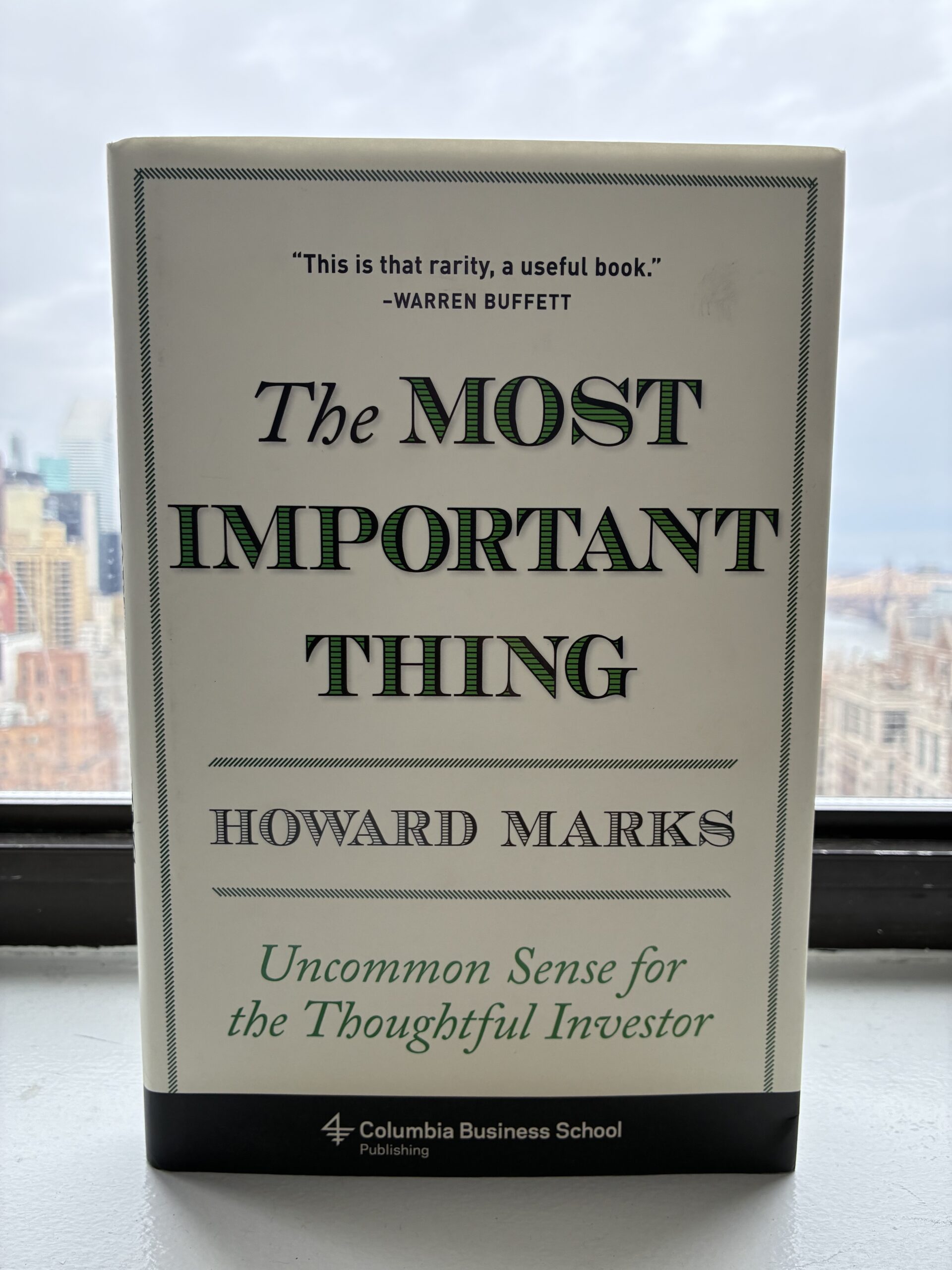
The Most Important Thing
Howard Marks · Book Summary
Marks’s framework for second-level thinking, the nature of risk, and why understanding market cycles matters more than predicting them. The most rigorous philosophical account of what investing actually requires.
ℹ Disclosure: This post contains Amazon affiliate links. If you buy through them, we earn a small commission at no extra cost to you. We only link to books we’ve read and recommend.
In a market where everyone has access to the same information, an investment edge can only come from thinking differently and better than the consensus — not just thinking correctly. Marks calls this second-level thinking. The rest of the book is an examination of what that thinking actually requires: understanding risk, reading market cycles, and knowing the difference between price and value.
Overall rating
7.6/10
The most rigorous philosophical account of what active investing requires. Dense, demanding, and genuinely original — but more useful for shaping how you think than for telling you what to do.
There is no single most important thing — which is the point
The book originated as a series of memos Marks wrote to Oaktree Capital clients over decades. The memos were not written as a curriculum — they were written in real time, as Marks was thinking through the markets he was navigating. That origin gives the book an intellectual honesty that more deliberately structured investing texts sometimes lack.
Marks structures the book as 20 chapters, each titled “The Most Important Thing Is…” — the implication being that investing requires holding 20 things in mind simultaneously, and that anyone offering a simpler framework is leaving something out. The structure is deliberate provocation: it runs against the finance industry’s preference for simple rules and clear prescriptions.
The book’s central and most famous contribution is the concept of second-level thinking. First-level thinking is the thinking that most investors do: is this a good company? Are earnings growing? Is the economy improving? Second-level thinking asks a prior question: what does the market currently believe about this company, and is my assessment sufficiently different from that consensus to generate an edge? In a market where millions of analysts examine the same data and reach similar conclusions, first-level thinking produces average outcomes by definition.
The remainder of the book is an elaboration of what second-level thinking actually requires in practice — an understanding of risk that goes beyond volatility, an ability to read where in the market cycle conditions currently sit, and the psychological discipline to act on conclusions that diverge from the consensus even when the social pressure to conform is intense.
The framework Marks builds across 20 chapters
The book covers more ground than any single summary can fully represent. These are the concepts that appear most directly in the second-level thinking framework and have the most practical application for investors at any level.
Can you think at the second level?
Marks’s definition of second-level thinking is deliberately demanding: it requires not just forming a view, but forming a view that is more accurate than the consensus view already embedded in the price. Most investors who believe they are thinking independently are simply thinking first-level thoughts that happen to differ from the consensus — which is different from having a better-evidenced view.
Second-level thinking is easier to describe than to do. It requires simultaneously holding the consensus view in mind, evaluating the evidence behind it, identifying where and why your assessment might differ, and then asking whether that difference is significant enough to act on. The six scenarios below test whether you can instinctively reach for the second-level question rather than stopping at the first.
6 scenarios. For each one, identify which response reflects genuine second-level thinking — the way Marks actually approaches markets.
Risk is not volatility. It is the probability of permanent loss.
Marks’s critique of volatility as the standard measure of risk is one of his most important contributions and one that most academic finance still resists. A stock that falls 40% in a year and recovers fully in two years has high volatility but low actual risk for a patient investor. A stock that falls 10% and never recovers has low volatility and catastrophic risk. The standard measure gets this backwards.
The book’s treatment of risk is its most original and most important contribution to investment thinking. Academic finance defines risk as volatility — the standard deviation of returns. Marks rejects this definition entirely. For a long-term investor, volatility is not risk. Temporary price declines are not risk. Permanent loss of capital — the irreversible impairment of the value of an investment — is risk.
This redefinition has significant practical consequences. It means that the investor who sells during a market decline, locking in a permanent loss, has experienced risk in a way that the investor who holds through the decline and recovers has not — even if both portfolios showed identical volatility on the way down. It means that the probability of loss matters more than the magnitude of price movements. And it means that risk management is fundamentally about identifying and avoiding situations where permanent impairment is possible, rather than constructing portfolios with low standard deviations.
You cannot predict cycles. You can know where you are in them.
Marks’s memo “You Can’t Predict. You Can Prepare.” is one of his most widely read and most practically useful pieces of writing. The distinction between prediction — knowing what will happen — and preparation — knowing what to do if various things happen — is the operational translation of second-level thinking into portfolio management. Preparing for scenarios is possible. Predicting which scenario will occur is not.
Marks does not claim to be able to predict market cycles. He claims something more modest and more useful: that it is possible to identify where in a cycle markets currently sit, and that this knowledge should influence how aggressively or defensively a portfolio is positioned. The indicators he uses are behavioral and attitudinal — the level of risk appetite in the market, the availability and terms of credit, the general mood of investors — rather than the quantitative economic forecasts that most cycle analysis relies on.
The practical implication is not market timing. It is portfolio calibration. When the available evidence suggests markets are in the late stages of an optimistic cycle — when credit is cheap and widely available, when investors are comfortable with risk, when prices are high relative to underlying values — the appropriate response is to position more defensively and hold more cash. Not to sell everything, and not to predict when the correction will come, but to acknowledge that the risk-reward tradeoff has shifted and adjust accordingly.
What the book gets right, where it asks more than it delivers, and who it is for
The book’s origin as a collection of memos means it was not designed with the coherence of a curriculum. Marks acknowledges this in his introduction. Some chapters feel like elaborations of the same point from different angles, and readers who are looking for a sequential build of ideas will find the structure occasionally frustrating. The second edition (2021) added commentary from other investors that helps but does not fully resolve this.
The framework is correct but incompletely operationalized
Marks describes second-level thinking with great precision. He is less precise about how to develop it. The book tells you that second-level thinking requires forming a view that differs meaningfully from the consensus and is better-evidenced than the consensus. It does not provide a systematic method for identifying what the consensus view actually is for any given security, nor for assessing whether your departure from it is well-founded or merely contrarian. This is not a flaw unique to Marks — it is inherent to any framework that depends on judgment rather than process.
The book assumes an active investing context
The Most Important Thing is written entirely within the framework of active investment management. The question of whether the game of second-level thinking is worth playing at all — given the evidence that most active managers underperform passive indices over long time horizons — is not seriously engaged. Marks would argue, correctly, that the investors who do have genuine second-level thinking ability can and do outperform. The book does not help you determine whether you are one of them.
Dense and demanding — this is not a casual read
The book assumes a level of financial literacy and investment experience that not all readers will have. Concepts like credit cycles, risk premiums, and portfolio positioning are used without the extensive explanation that a genuinely introductory text would provide. Readers coming to Marks without having read Graham first will find some sections difficult to fully grasp. The recommended reading sequence — Graham, then Marks — is not arbitrary.
The Wealth Shelf take on reading this book
Read it after The Intelligent Investor, not before. Graham provides the value investing foundation that Marks builds on — without it, Marks’s framework is harder to ground. When you do read it, read slowly: this is not a book that rewards skimming. The chapters on risk, cycles, and patient opportunism are the most immediately applicable. The chapter on second-level thinking is the one to return to whenever you find yourself acting on a thesis that the market has already fully priced in.
Three things the book makes immediately actionable
1. Apply the second-level test to every investment thesis you hold
The second-level test has two parts that must both be satisfied: your view must differ from the consensus, and your view must be more accurate than the consensus. Differing from the consensus without being more accurate is just being wrong in a distinctive way. Most contrarian investment theses fail the second part of the test.
For every stock or fund you own, write down in one sentence what the market currently believes about it — why it is priced where it is. Then write down how your view differs from that consensus belief, and why you think your assessment is better-evidenced than the market’s. If you cannot complete either sentence clearly, you do not have a second-level thesis — you have a preference. Most portfolio reviews will reveal that the majority of positions fail this test.
2. Assess the current market cycle using Marks’s behavioral indicators
Marks’s cycle checklist is behavioral, not quantitative. Ask: how easy is it to get a loan right now? How willing are investors to accept risk? Are people talking about the stock market at social gatherings? Is the news coverage of investing positive or negative? Are asset prices high or low relative to historical norms? These questions do not tell you when a cycle will turn — Marks is explicit that nobody can know that. They tell you where in the cycle conditions suggest you are, which should influence how aggressively or defensively you are positioned.
3. Redefine what risk means in your own portfolio
Replace volatility with permanent loss as your primary risk measure. For each position you hold, ask: under what realistic scenarios could this investment suffer permanent, unrecoverable impairment — not just a temporary decline, but a genuine destruction of underlying value? Positions that could suffer permanent loss at realistic probabilities are risks in Marks’s sense. Positions that might decline significantly but will recover as long as you can hold through the decline are not risks — they are temporary discomfort that patient investors can exploit.
Where to go after The Most Important Thing
The most rigorous account of what active investing actually requires — and the most honest about how hard it is.
The Most Important Thing is not a book for everyone, and Marks would be the first to say so. The framework he describes — second-level thinking, genuine understanding of risk, calibrated cycle positioning — requires a combination of intellectual capacity, emotional discipline, and investment experience that most investors do not possess, and that no book can install.
Its value lies in two things: first, in giving serious investors the most precise available description of what sustained active management excellence actually looks like; and second, in giving investors of all kinds the tools to think more carefully about risk, cycles, and the gap between price and value. Even investors who conclude, correctly, that passive indexing is the right strategy for them will think about their approach with greater clarity after reading Marks.
Read next in the library: Richer, Wiser, Happier — William Green profiles Marks directly, providing the biographical and psychological context for the framework this book describes in the abstract. The two books read as natural companions. →
Buy The Most Important Thing on Amazon →