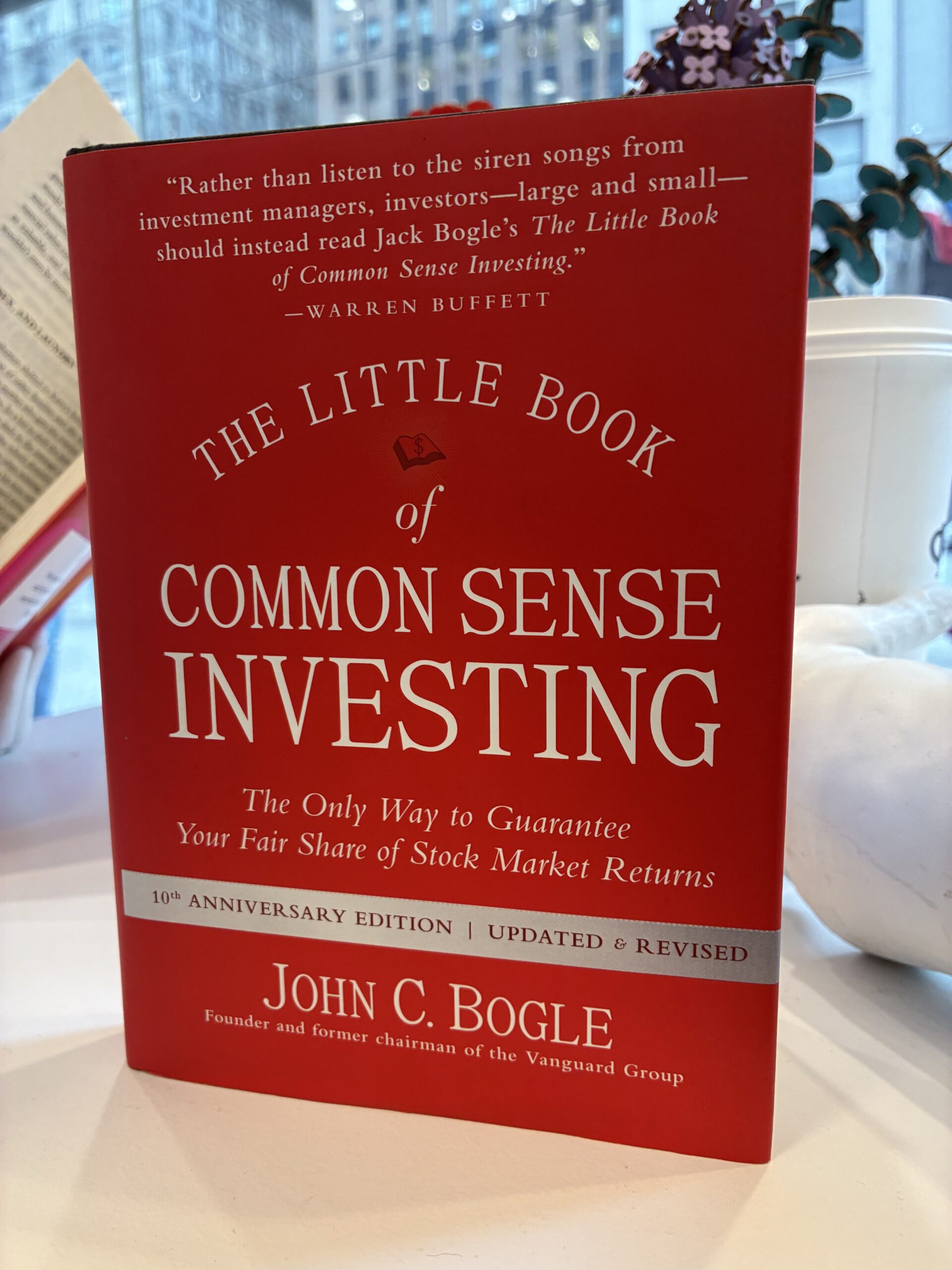
The Little Book of Common Sense Investing
John C. Bogle · Book Summary
The man who invented the index fund makes the empirical case for why it beats almost everything else. The argument is arithmetic, not opinion.
ℹ Disclosure: This post contains Amazon affiliate links. If you buy through them, we earn a small commission at no extra cost to you. We only link to books we’ve read and recommend.
The stock market delivers a certain return. Every dollar paid in costs is a dollar that never compounds. Over 20 years, only 18% of actively managed funds beat their benchmark index — and that’s before taxes. Bogle’s argument is arithmetic, not opinion: in investing, you get what you don’t pay for. The index fund is the only product that proves it.
Overall rating
8.0/10
The empirical case for index investing, made by the man who invented the index fund. The argument is arithmetic. The data is unambiguous.
You get what you don’t pay for
Bogle founded Vanguard in 1974 and launched the first index fund available to individual investors in 1976. The financial industry called it “Bogle’s folly.” Vanguard now manages over $8 trillion.
Jack Bogle spent fifty years making one argument. It is not complicated. The stock market delivers a return. Every dollar paid in costs — management fees, transaction costs, advisor commissions, tax drag — is a dollar that never compounds. Over decades, the arithmetic of cost drag is more powerful than almost any other variable in investing. More powerful than stock selection. More powerful than market timing. More powerful than which funds you choose, as long as the costs are low.
Bogle founded Vanguard in 1974 on a single premise: that a fund company owned by its investors, with no external shareholders to pay, could pass the cost savings directly to the people investing in it. The first index fund available to individual investors launched in 1976. The financial industry called it Bogle’s folly. Today, index funds account for more than half of all US equity fund assets.
The Little Book of Common Sense Investing, first published in 2007, is the distilled version of the case Bogle had been making for three decades. It is short, repetitive, and almost entirely data-driven. It makes the same argument multiple times because the argument keeps being ignored. Most people who read it once agree with it. Very few act on it.
The arithmetic that makes the case
Bogle’s argument is not a theory. It is arithmetic applied to 80 years of market data. Each of the following principles is independently verifiable and none of them has been meaningfully challenged.
What the fee difference actually costs over 30 years
The numbers below use $500/month contributions and a 7% gross market return — conservative assumptions. The cost drag at 1.5% is not a small rounding error. It is a life-changing sum.
The difference between a 0.05% expense ratio and a 1.5% expense ratio sounds trivial. One and a half percent is not a large number in isolation. Over 30 years of compounding, it is not a trivial number at all. The visualizer below shows what happens to two investors who make identical contributions into a market generating identical returns — with the only difference being what they pay.
Same market return. Same contributions. The only difference is what each investor pays in fees. Hover over the chart to see the gap at any point.
Assumptions: $500/month contributions, 7% gross annual market return, 30-year horizon. Index fund: 0.05% expense ratio (Vanguard VTSAX). Active fund: 1.5% expense ratio (industry average per Morningstar). No taxes modeled.
What this means in practice
The cost drag visualization above uses conservative assumptions. Real active fund costs are often higher than 1.5% when transaction costs and tax drag are included. The gap between the two lines is not an argument for a particular fund — it is an argument for the category. Any fund with an expense ratio below 0.1% captures almost all of the available market return. Any fund above 0.5% is making a significant mathematical bet against compounding.
The prescription is simpler than the industry wants you to believe
Bogle’s recommended portfolio for most investors: one total US stock market index fund. That’s it. The complexity of the investment industry exists to justify fees, not to improve returns.
Bogle’s investment prescription fits in two sentences: buy a total stock market index fund with the lowest possible expense ratio. Hold it forever. Everything else — fund selection, market timing, tactical allocation shifts, alternative investments — adds complexity, cost, and in most cases, reduces returns.
For the defensive investor
Bogle recommended a simple two-fund portfolio for most people: a total US stock market index fund and a total US bond market index fund, in a ratio that reflects your time horizon and risk tolerance. Younger investors hold more stocks. Older investors shift toward bonds. Rebalance once a year. The total annual cost should be below 0.1%.
On international diversification
Bogle was skeptical of international diversification, arguing that large US companies already generate significant international revenue and that currency and political risk offset much of the theoretical diversification benefit. Most index fund advocates today disagree with him on this point — a total world index fund is a reasonable alternative — but the cost discipline argument applies equally regardless of which index you choose.
What Bogle got right, and one thing worth questioning
Cap-weighted index funds own more of what has already gone up. In a market dominated by a small number of large technology companies, this is a concentration risk that Bogle’s original framework did not fully account for.
The cost argument is unassailable
No serious financial economist disputes the central thesis. The arithmetic of cost drag is not a matter of opinion. The 82% figure — that 82% of active funds underperform their benchmark over 20 years — has been replicated across markets, time periods, and geographies. The argument Bogle makes in this book is correct.
The concentration problem
Cap-weighted index funds — which own stocks in proportion to their market capitalization — have a structural characteristic that Bogle did not fully address: they automatically own more of what has already become expensive. In 2024, the top ten stocks in the S&P 500 represented approximately 35% of the index’s total value, with the five largest technology companies alone accounting for over 25%. An investor in a total market index fund has significant concentration in a small number of companies. This does not invalidate the cost argument — it is an additional risk factor worth understanding.
The behavior gap
Bogle’s prescription requires doing almost nothing for decades. That is harder than it sounds. The investors who underperform index funds most dramatically are not the ones who chose the wrong active fund — they are the ones who sold their index funds during a crash and bought back in after the recovery. The book makes the intellectual case for staying the course. Making the behavioral case is harder, and Bogle acknowledges this without fully solving it.
The Wealth Shelf take on reading this book
Read it once and act on it immediately. The argument does not require a second reading to understand — it requires the courage to implement something that feels too simple to be right. The simplicity is the point. Open a Vanguard, Fidelity, or Schwab account. Buy VTSAX, FSKAX, or SWTSX. Set up automatic contributions. Stop checking it. Bogle spent fifty years proving that this is enough.
Three things the book makes immediately actionable
1. Check what you are currently paying
Find the expense ratio of every fund you currently own. If any of them are above 0.5%, you have a cost drag problem that is compounding against you right now. The fix is straightforward: move to a low-cost equivalent. Vanguard, Fidelity, and Schwab all offer total market index funds with expense ratios below 0.05%. The tax implications of switching are worth calculating, but for most people in tax-advantaged accounts the answer is to switch immediately.
2. Simplify your portfolio
Bogle’s portfolio for most people: one fund. VTSAX or equivalent. The complexity of most investment portfolios reflects the industry’s need to justify fees — not the investor’s need for better returns.
If you currently own more than three funds, ask whether the additional funds are adding diversification or adding cost. Most people who own ten funds own overlapping positions that could be consolidated into one or two index funds with lower total cost and equivalent or better diversification. Complexity in a portfolio is usually a sign that someone sold you something, not that you made a deliberate decision.
3. Automate and stop watching
The behavior gap — the difference between what index funds return and what the average index fund investor earns — exists almost entirely because people sell during downturns and buy back in after recoveries. The solution is automation: set up automatic monthly contributions, turn off portfolio notifications, and commit to not checking the balance more than once a quarter. Bogle’s returns require Bogle’s patience. The two are inseparable.
Where to go after The Little Book of Common Sense Investing
Read it. Then open an account and do exactly what it says.
The Little Book of Common Sense Investing is one of the few personal finance books where reading it and acting on it are essentially the same thing. The prescription is clear, the evidence is overwhelming, and the implementation requires an afternoon and an internet connection.
The reason most people don’t follow Bogle’s advice is not that it’s complicated. It’s that it’s boring. The financial industry has spent decades convincing people that investing requires expertise, attention, and constant adjustment. Bogle spent fifty years proving the opposite. He was right.
Read next in the library: The Simple Path to Wealth — Collins takes Bogle’s empirical case and builds a complete life framework around it. The most actionable implementation of everything this book proves. →
Buy The Little Book of Common Sense Investing on Amazon →