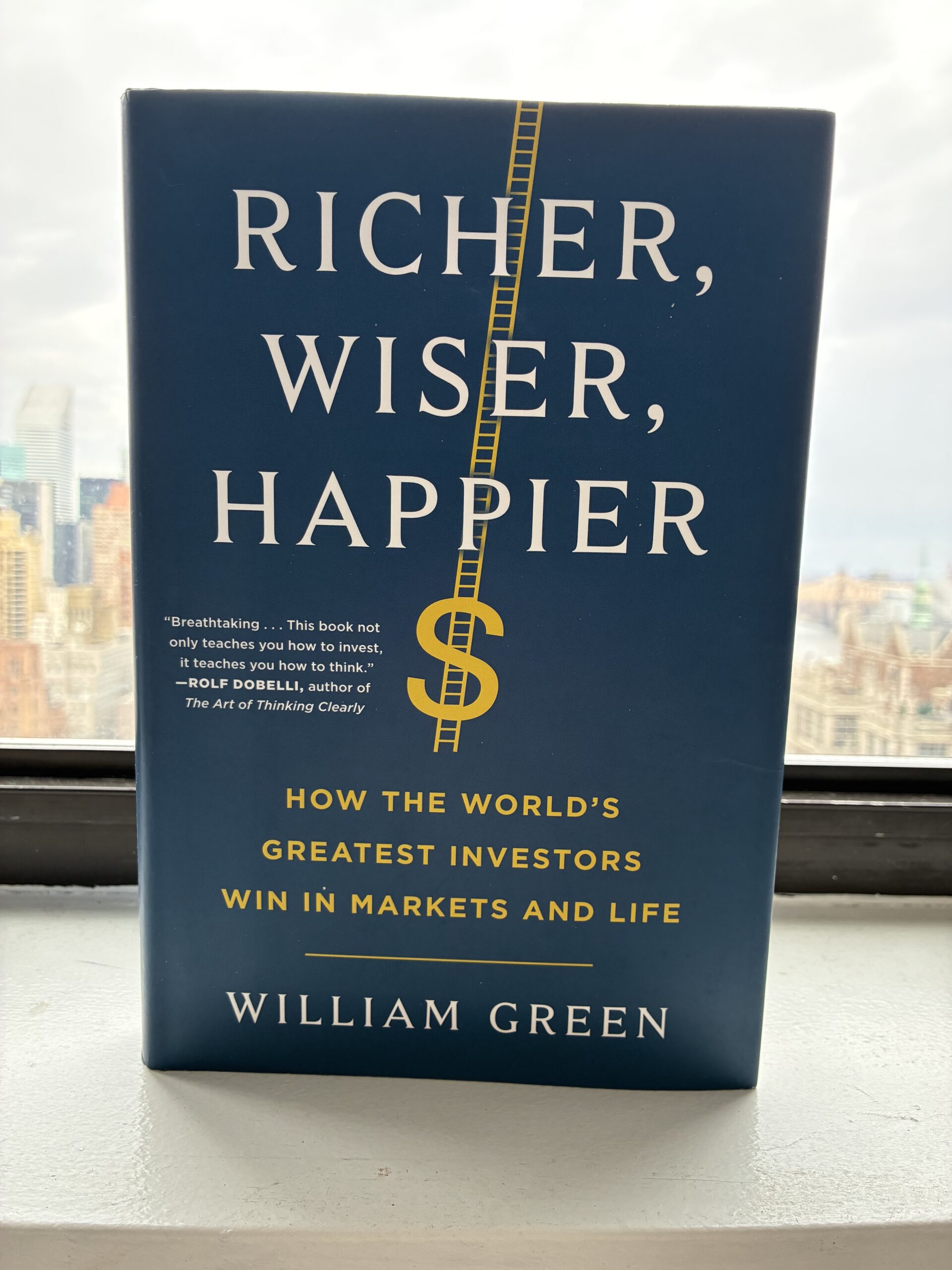
Richer, Wiser, Happier
William Green · Book Summary
Decades of interviews with the world’s greatest investors, distilled into the principles they actually live by. Not what they say — what they do, how they think, and what separates sustained excellence from one lucky cycle.
ℹ Disclosure: This post contains Amazon affiliate links. If you buy through them, we earn a small commission at no extra cost to you. We only link to books we’ve read and recommend.
William Green spent decades interviewing the world’s best investors. What he found wasn’t a formula. It was a set of inner qualities — patience, intellectual honesty, the ability to think independently, the willingness to do nothing — that the greatest investors share regardless of their style. The investment strategy is almost secondary. The mind running it is everything.
Overall rating
8.0/10
The most readable book in the value investing section and the one most likely to change how you think rather than what you do. Green is a gifted writer who earns access that no one else has had.
What Green actually set out to do — and why it’s different from every other investing book
Green spent decades as a financial journalist gaining deep access to investors who almost never speak candidly. The book took years to write because it required building relationships, not just conducting interviews. The intimacy of the profiles reflects that investment of time.
Most investment books are either autobiographies (the investor explaining what they did), frameworks (a theory of markets or valuation), or data analyses (empirical research on what works). Richer, Wiser, Happier is none of these. It is long-form journalism — the product of William Green’s decades of access to investors who are almost never interviewed with this depth or candor.
Green’s subjects include Charlie Munger, Howard Marks, John Templeton, Joel Greenblatt, Mohnish Pabrai, Bill Miller, Nick Sleep, and others. None of them share the same investment methodology. What Green set out to find was not the common strategy but the common psychology — the inner qualities that allow certain investors to sustain exceptional performance across decades and across wildly different market conditions.
The answer, which the book builds toward slowly and compellingly, is that the investment strategy matters far less than most people assume. The mind running the strategy — its patience, its intellectual honesty, its ability to hold conviction without becoming attached to being right — is the actual differentiating factor. You cannot copy Munger’s latticework of mental models without also doing the decades of reading that built them. You cannot copy Pabrai’s cloning strategy without also having Pabrai’s emotional detachment from short-term results.
What the world’s best investors actually share
Green does not present a numbered list of qualities — the book is more organic than that. But across the profiles, five consistent inner qualities emerge in every investor he profiles, regardless of whether they run a hedge fund, a family office, or a simple personal portfolio.
Which of Green’s investor archetypes are you?
Green’s insight is that no single archetype is superior. Munger’s systems approach, Marks’s risk obsession, Templeton’s contrarianism, Pabrai’s disciplined cloning, and Greenblatt’s mechanical value process have all produced extraordinary long-term results. What matters is matching your approach to your actual temperament — and then having the discipline to stick with it.
Green profiles investors with radically different approaches who all achieved extraordinary results over long periods. The differences between them aren’t random — they reflect genuine differences in temperament, risk tolerance, and intellectual style. Understanding which archetype fits your own psychology is the first step toward building an approach you can actually sustain through the inevitable periods of underperformance.
8 questions. Based on the investors profiled in Richer, Wiser, Happier. Find out which archetype matches your investment psychology.
The investors Green profiles — and what each one actually teaches
Nick Sleep and Qais Zakaria of Nomad Investment Partnership are among the least-known investors in the book but arguably the most instructive. Their letters are now publicly available and widely studied. Green’s profile is the most accessible introduction to their thinking for investors who haven’t read the original correspondence.
Charlie Munger — The systems thinker
Green’s Munger chapter is the best short account of Munger’s actual intellectual method. The latticework of mental models isn’t a metaphor — it is Munger’s literal approach to building a mind capable of avoiding the cognitive errors that destroy most investors. He reads voraciously across disciplines not because he enjoys it (though he does) but because each discipline provides a new lens that prevents the over-reliance on a single framework. The chapter’s most useful contribution is explaining why Munger’s method cannot be shortcut: the models only work once they are genuinely internalized, not when they are consulted as a checklist.
Howard Marks’s concept of second-level thinking — asking not just “is this a good company?” but “is it better than what the market already believes about this company?” — is the most practically applicable idea in the book for investors who want to do individual stock analysis. First-level thinking produces average outcomes because everyone with access to the same information tends to reach similar conclusions.
Howard Marks — The risk manager
Marks’s chapter reframes what investment skill actually is. Most investors think of skill as the ability to identify good investments. Marks thinks of skill primarily as the ability to understand and manage risk — specifically, the risk of permanent loss. His concept of second-level thinking is the book’s most directly applicable tactical idea: in a market where millions of analysts are all looking at the same information, an edge only exists when your assessment of the most likely outcome differs meaningfully from the market’s consensus view.
John Templeton — The contrarian
Templeton’s chapter is about the psychology of buying at maximum pessimism — the ability to act decisively when every available signal suggests you shouldn’t. Green uses Templeton’s career to make a point that goes beyond contrarianism as a style: that the best opportunities consistently appear when fear has driven prices below any reasonable estimate of intrinsic value, and that taking advantage of them requires both the analytical work to know the value and the psychological constitution to act against the crowd.
Mohnish Pabrai — The cloner
Pabrai’s chapter is the most immediately practical for investors without professional research resources. His cloning strategy — systematically reviewing the 13F filings of investors whose judgment he trusts and selectively copying their highest-conviction positions — is a disciplined acknowledgment that original research has diminishing returns once a small number of highly skilled analysts have already done the work. The chapter is also candid about the psychological challenge: cloning requires accepting that your best ideas may be someone else’s, which runs against most investors’ self-image.
What the book delivers, where it falls short, and who it is actually for
Green is explicit about this limitation in the book itself. The qualities he identifies — patience, intellectual honesty, independence, the ability to sit still — are genuine. But he acknowledges that knowing what these qualities look like is different from being able to cultivate them. The book diagnoses better than it prescribes.
Green is a journalist, not an investor — which is both the book’s strength and its limit
The book’s greatest strength — Green’s access and his ability to write about complex investors in genuinely compelling prose — is inseparable from its central limitation. Green can tell you what Munger’s latticework of mental models looks like from the outside with more clarity than almost anyone. He cannot tell you how to build one, because building it is the work of a lifetime of specific reading and reflection that no book can substitute for. Richer, Wiser, Happier is an extraordinary map of a territory. It is not a guide to the territory itself.
The book is more useful for long-term individual investors than for index fund adherents
There is a tension at the heart of this book that Green does not fully resolve. The evidence from Bogle, Malkiel, and the DALBAR data consistently shows that most individual investors — even highly intelligent, well-read ones — underperform simple index funds over long time horizons. Green’s subjects are the exceptions: the small number of investors who genuinely have an edge. The book does not help you determine whether you are one of them. Readers who are already committed index investors will find the profiles fascinating but may find the actionable takeaways limited.
The “Happier” dimension is the book’s most surprising and most underrated contribution
The book’s title promises three things, and most readers focus on the first two. The “Happier” section — Green’s exploration of how the investors he profiles have thought about wealth, meaning, and the relationship between financial success and a good life — is arguably the most original material in the book. Templeton’s genuine contentment, Munger’s intellectual satisfactions, and Pabrai’s philosophical framework for thinking about giving are not decorative additions to an investment book. They are the honest accounting of what sustained financial success actually produces in the lives of people who have achieved it.
The Wealth Shelf take on reading this book
Read it for the psychology, not the tactics. The value investing mechanics are available in more rigorous form elsewhere — The Intelligent Investor for the theory, Warren Buffett’s Ground Rules for the application. What Green provides that no other book does is a close, candid portrait of what exceptional investors are actually like as thinkers — their habits, their blind spots, their sources of conviction, and the psychological qualities that allow them to hold positions through the kind of short-term pain that forces most investors to sell. Read it alongside Poor Charlie’s Almanack for the most complete picture of how Munger actually operates.
Three things the book makes immediately actionable
1. Identify your actual circle of competence — then stay inside it
Munger’s definition of the circle of competence is more demanding than most investors assume. It is not the industries you find interesting or the companies whose products you use. It is the narrow set of situations where your specific knowledge genuinely gives you an analytical edge over the market’s collective assessment. Most investors have a much smaller circle than they believe.
Every investor Green profiles has a clear, honest understanding of what they know and what they don’t — and they operate almost exclusively within the former. Write down your genuine circle of competence: the specific industries, business models, or situations where your knowledge is materially better than the average informed observer. Then audit your portfolio against it. Any position outside that circle is a bet on your ability to learn faster than the professionals already analyzing it.
2. Read your own investment decisions against the second-level thinking standard
For any stock you own or are considering, write down: what does the market currently believe about this company? Then write down: what do you believe that differs from that consensus view? If you cannot identify a specific, reasoned disagreement with the market’s current assessment, you do not have an edge — you have a preference. The second-level thinking test, drawn from Marks, is the most practically useful single tool in the book.
3. Define your investment edge — or concede that you don’t have one
The most honest takeaway from Richer, Wiser, Happier is also the most uncomfortable: the investors Green profiles genuinely have an edge that justifies active management. Most investors do not. Asking yourself honestly whether you have the temperament, the circle of competence, and the emotional constitution to outperform a simple index fund is not a defeatist exercise — it is the most important investment decision you will make. Most readers of this book will conclude, correctly, that their best investment approach remains the low-cost index fund that Bogle and Collins recommend. The book’s value for those investors is not tactical. It is philosophical: understanding how the best investors think makes it easier to sustain the discipline that passive investing requires.
Where to go after Richer, Wiser, Happier
The best account of what exceptional investors are actually like — and the most honest about what you can and cannot learn from them.
Richer, Wiser, Happier is the most readable book in the value investing section of this library, and the one most likely to change how you think rather than what you do. Green’s access is unparalleled, his writing is genuinely excellent, and the portraits he draws of Munger, Marks, Templeton, and Pabrai are the most complete available in a single volume.
Its honest limitation is that it describes qualities that cannot be directly installed. You cannot read your way to Munger’s patience or Marks’s risk discipline — you can only understand what those qualities look like and then do the long work of cultivating something similar. For investors committed to passive strategies, the book’s value is philosophical. For investors doing individual stock analysis, it is indispensable.
Read next in the library: Poor Charlie’s Almanack — Green’s Munger profile is the best introduction; Munger’s own writing is the destination. The Almanack shows the full architecture of the mind Green spent a chapter describing. →
Buy Richer, Wiser, Happier on Amazon →