I Will Teach You to Be Rich:
Summary & Honest Review
Ramit Sethi’s bestseller promises a 6-week program that actually works. The title is deliberately provocative. The content delivers. Here’s every key idea — and an honest assessment of where the advice has real limits.
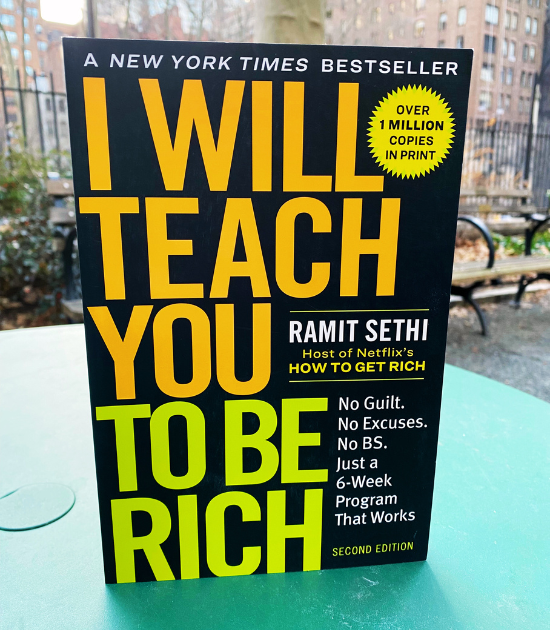
Stop budgeting. Start automating. Set up the right accounts in the right order, point them at low-cost index funds, and let the system run. Spend freely on what you genuinely love — cut without guilt on what you don’t. A rich life is designed, not defaulted into. Sethi’s job is making starting easy enough that you actually do it.
I Will Teach You to Be Rich — Rated
What Is I Will Teach You to Be Rich?
First published in 2009 and substantially updated in 2019, I Will Teach You to Be Rich grew out of Ramit Sethi’s personal finance blog of the same name. Sethi studied technology and psychology at Stanford, and the combination shows: the book is as interested in why people don’t act on good financial advice as it is in what that advice actually is.
The premise is direct. Most personal finance books explain what to do without making it easy to start. Sethi’s solution is a six-week program — a concrete sequence of account setups, automation triggers, and financial decisions — designed to get the system built before motivation runs out. Once the system is running, you can largely stop thinking about money. That is the point.
The Core Argument
85% right and actually done beats 100% right and still procrastinating. This is the most important thing Sethi understands that most finance books miss.
Sethi opens with a challenge to conventional finance thinking: the problem is not information. Most people already know they should spend less and save more. The problem is behavior — the gap between knowing and doing. And the solution is not willpower. It is systems.
His core argument: automate the right behaviors so they happen without a decision. Set up automatic transfers to investment accounts on payday. Automatic credit card payments in full. Automatic contributions to your 401(k). Once automated, good financial behavior happens by default. Sethi calls this winning without trying — and it is the structural insight that makes the book genuinely useful in a way most personal finance writing is not.
What the Six Weeks Actually Cover
Week 1 covers credit cards as a tool to be optimized, not avoided — rewards, credit-building, purchase protections, and negotiation scripts for reducing fees and rates. Week 2 covers the move to high-yield online savings accounts. Week 3 covers the investment account setup sequence — the Ladder of Personal Finance. Week 4 introduces the Conscious Spending Plan and the automation architecture that connects everything together. Weeks 5 and 6 cover what to actually invest in and how to handle specific situations: debt payoff timing, big purchases, salary negotiation.
Sethi’s six-rung investment sequence — hover each rung for detail
401(k) to employer match
Pay off high-interest debt
Open and fund a Roth IRA
Max out your 401(k)
HSA if available
Taxable investment account
Four Concepts Worth Keeping
Conscious spending is the permission structure the Psychology of Money never quite gives you. It makes the whole system psychologically sustainable.
Conscious Spending — Not Budgeting
Sethi is explicitly anti-budget. Traditional budgeting requires constant attention, creates guilt around every purchase, and fails most people because it treats all spending as equally negotiable. His alternative is the Conscious Spending Plan: a simple allocation of income into four buckets — fixed costs, investments, savings goals, and guilt-free spending — set up once and then automated.
The crucial element is the guilt-free bucket. Once fixed costs and investment targets are hit, the remaining portion is yours to spend on whatever you want — no justification required. If the investment infrastructure is already in place, the guilt is unnecessary. This reframe is what makes the system psychologically durable.
“Investing is for rich people.” “I’ll start when I earn more.” These invisible scripts explain why smart people make bad financial decisions for years.
Invisible Scripts — The Stories Running Your Finances
One of Sethi’s most useful concepts is what he calls invisible scripts — unexamined beliefs about money absorbed from parents, culture, and experience that shape decisions without conscious awareness. Examples: “talking about money is rude,” “investing is complicated and risky,” “I should pay off all debt before investing.” These scripts feel like facts. Sethi’s goal is to surface and challenge them with data.
The Rich Life — Defining Your Own Version
The philosophical core of the book: “rich” is subjective. A rich life might mean traveling extensively, eating at good restaurants, retiring early, or none of those things. What it is not, Sethi argues, is a number pursued for its own sake. Identify the two or three things that genuinely make your life better, spend extravagantly on those, and cut everywhere else without guilt.
“There’s a limit to how much you can cut, but no limit to how much you can earn.” Most finance books spend 200 pages on cuts and one page on this.
Earning More — The Variable Most Books Ignore
Most personal finance books focus almost entirely on spending and saving. Sethi is unusual in spending significant time on earning — salary negotiation, freelancing, and building income alongside standard investment advice. The salary negotiation scripts are some of the most practically useful pages in the genre: direct, specific, and based on the observation that most people leave significant money on the table simply by never asking.
What I Will Teach You to Be Rich Gets Right
Three things stand out. First, the automation architecture is genuinely original and genuinely useful. No other personal finance book explains as clearly how to connect accounts, set up automatic transfers, and remove financial decisions from the daily mental load. Second, the Conscious Spending Plan is a better framework than traditional budgeting for most people — it accounts for human psychology in a way a spreadsheet budget does not. Third, the invisible scripts chapter is the most psychologically sophisticated treatment of money beliefs in popular personal finance writing.
Where It Falls Short
The book is written for a specific American in their mid-20s. That person will get enormous value. Everyone else needs to translate — sometimes aggressively.
The most significant limitation is US-specificity. The book is built around American financial infrastructure — 401(k)s, Roth IRAs, specific banks, specific fund providers — in a way that makes it difficult for international readers to apply directly. The principles translate; the specific recommendations do not.
The anti-frugality stance requires careful reading. Sethi’s message is correct for readers who have the income to fund both investment targets and lifestyle. For income-constrained readers, the framing can be misread as permission to spend rather than a framework for prioritizing. And the investment philosophy is correct but thin — Sethi points you toward index funds without fully explaining why they work. For that, you need Bogle.
The Conscious Spending Plan, invisible scripts, and automation principles apply universally. For account-specific recommendations, find your local equivalents: employer pension matching (equivalent to 401k), tax-advantaged investment accounts (ISA in the UK, TFSA in Canada), and low-cost index fund providers in your market. The sequence — employer match first, high-interest debt second, tax-advantaged accounts third — translates directly.
The Right Reader for This Book
Read I Will Teach You to Be Rich if you are in your 20s or early 30s, have no investment accounts set up, and have been avoiding the topic because it feels complicated. This book removes that excuse more effectively than anything else available. It is also the right book for anyone who has absorbed the psychology and philosophy of personal finance (Housel, Collins) and now needs a concrete implementation plan.
Supplement with Bogle if you want the full evidence base for the index fund recommendation. Read Collins if you want the deeper philosophy behind the automation Sethi describes.
Where to go after I Will Teach You to Be Rich
Sethi gives you the system. Housel explains why you’ll abandon it under pressure. Read Housel first — he’s the mindset layer Sethi assumes you already have.
Sethi tells you to automate into index funds. Collins explains the deeper philosophy — why one fund, held for decades, beats almost everything else.
Sethi points you toward index funds. Bogle proves the case with 40 years of fund data. The evidence behind every recommendation Sethi makes.
I Will Teach You to Be Rich is the most actionable personal finance book available. If you are in your 20s or early 30s, have never set up an investment account, and have been putting it off because it feels complicated — this book removes every excuse and builds the system for you in six weeks.
Its limitations are real but narrow: US-specificity, an anti-frugality framing that needs careful reading, and an investment philosophy that is correct but thin. For the deeper case, you need Collins and Bogle. But as a starting system, it is hard to beat.