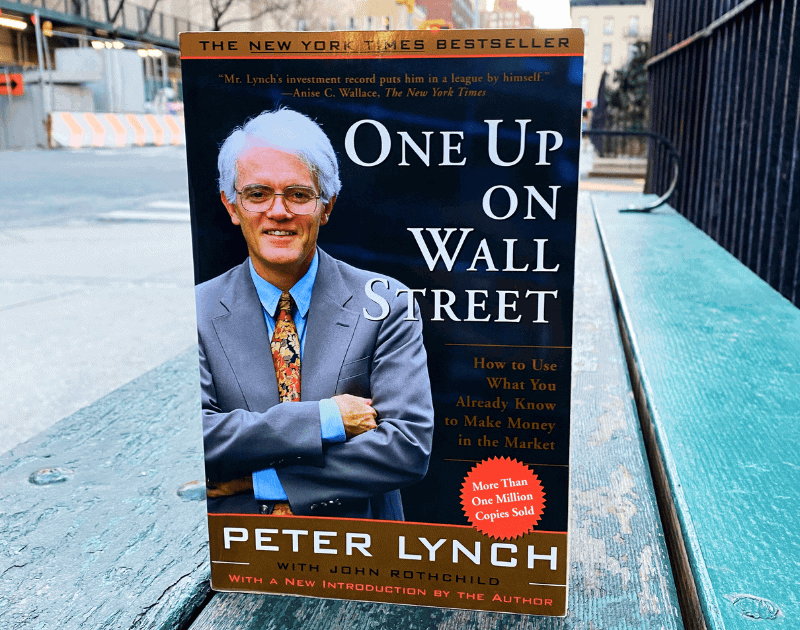
One Up on Wall Street
Peter Lynch · Book Summary
The man who generated 29.2% average annual returns for 13 years makes the case that ordinary investors have real advantages over professionals. He is right — and honest about how rarely those advantages are actually used.
ⓘ Disclosure: This post contains Amazon affiliate links. If you buy through them, we earn a small commission at no extra cost to you. We only link to books we’ve read and recommend.
Individual investors have real advantages over professional fund managers. You can spot great companies in your daily life before Wall Street notices them. You can hold without restriction, act without committee approval, and think in years rather than quarters. Lynch’s argument is that these advantages are real — and that most individual investors squander them entirely.
Overall rating
7.4/10
The best case ever made for individual stock picking — written by the man who had the best reason to make it. Read it knowing his results were exceptional and his conditions were specific.
The individual investor’s advantages are real — and almost universally wasted
Lynch managed Fidelity’s Magellan Fund from 1977 to 1990. During that period, the fund grew from $18 million to $14 billion in assets. His 29.2% average annual return is one of the best long-term track records in the history of fund management.
Peter Lynch ran the Fidelity Magellan Fund for thirteen years and generated one of the most extraordinary performance records in investment history. He did it, he argues, not because he was smarter than other investors — but because he paid attention to what was happening around him, did the fundamental work to verify what he observed, and held his convictions long enough for them to pay off.
One Up on Wall Street is the book Lynch wrote to explain how he found his best investments — and to make the case that ordinary investors, paying attention to their own lives and industries, have access to the same raw material. The nurse who sees a medical device transforming patient outcomes. The teacher who watches an education platform change how students learn. The consumer who notices a brand achieving something competitors are not. These observations, Lynch argues, are not tips — they are the starting point for genuine investment research.
The book’s central tension is one Lynch acknowledges directly: the advantages he describes are real, but most individual investors squander them entirely. They buy on tips. They sell on panic. They confuse activity with intelligence. They ignore their edge when they have one and manufacture conviction when they do not. The advantages Lynch describes are available to anyone. The discipline required to use them is considerably rarer.
Lynch’s classification system for every stock
Lynch’s six categories are not just a classification system — they are a framework for setting return expectations and holding periods before you buy. Knowing which category a stock belongs to tells you how to hold it.
Before buying any stock, Lynch wants to know what kind of company it is. The category determines the expected return, the appropriate holding period, and the warning signs to watch for. Most investors skip this step entirely — they buy without a framework for what success or failure looks like. Lynch’s six categories are the antidote.
01
Slow Growers
Large, mature companies growing slightly faster than the economy. Lynch holds these for dividends, not growth. The risk is complacency — a slow grower that stops growing is not a hold, it is an exit.
02
Stalwarts
Large companies growing at 10–12% per year. Coca-Cola, Procter & Gamble. Lynch expects 30–50% gains over a few years and moves on. Not multibaggers — reliable performers in a diversified portfolio.
03
Fast Growers
Small, aggressive companies growing at 20–25% per year. Lynch’s favorites. The risk is that growth slows or the company expands into markets it does not understand — what Lynch calls diworsification.
04
Cyclicals
Companies whose sales and profits rise and fall with the economic cycle — airlines, car manufacturers, steel producers. Timing matters enormously. Buying a cyclical at the wrong point in the cycle is worse than not buying at all.
05
Turnarounds
Companies that have been depressed, battered, or written off — and have a credible path back. Lynch made significant money on turnarounds but is clear about the risk: many never turn around. Due diligence on the balance sheet is non-negotiable.
06
Asset Plays
Companies sitting on assets that the market has not valued correctly — cash, real estate, patents, or subsidiaries. Lynch discovered several of these through sector knowledge and local observation. The edge here is knowing what the asset is actually worth.
Lynch’s most important single tool
The two-minute drill is not just a buying filter. Lynch uses it as an ongoing monitoring tool. When the thesis changes materially — not when the price moves — that is the signal to act.
Before buying any stock, Lynch requires that you be able to explain in two minutes or less why you own it. Not a vague thesis — a specific statement of what the company does, why it is positioned to succeed, and what has to happen for the stock to perform. If you cannot articulate this clearly, you do not have conviction. You have hope dressed as analysis.
The two-minute drill also serves as an ongoing monitoring tool. When something changes — a new competitor, a management shift, a product failure — you run the drill again against the new facts. If the thesis still holds, you hold. If it has changed materially, you exit. The drill prevents both premature selling on noise and stubborn holding through genuine thesis breaks.
Lynch’s two-minute drill — applied
For any stock you currently own or are considering: state the company name, describe what it does in one sentence, explain why it is positioned to outperform its competitors, and name one specific thing that has to happen for the stock to perform well over the next three years. If any of those four elements is missing or vague, you do not yet have the information required to own it.
Lynch’s framework applied to your situation
Lynch is honest about this: the retail advantages he describes are real only for investors who actually have industry knowledge, financial literacy, and behavioral discipline. Most individual investors have one of the three. Very few have all three.
Lynch’s case for individual investing rests on the existence of a genuine edge. Not enthusiasm, not conviction, not a good tip from a trusted source — an actual informational or analytical advantage over the other participants in the market. The checklist below applies his criteria directly. Be honest.
Lynch’s argument is that individual investors can beat the market — but only when they have a genuine advantage. Check every statement that currently applies to you.
What Lynch gets right and what the record actually shows
Lynch’s Magellan returns are real and verifiable. What is less often discussed: the average Magellan investor significantly underperformed the fund itself during Lynch’s tenure, because they bought after strong performance and sold during downturns.
Lynch’s conditions were exceptional
Lynch managed Magellan during one of the most sustained bull markets in US stock market history. The 1977 to 1990 period was not a representative sample of market conditions. His ability to run a relatively concentrated fund without the redemption pressure that plagues most institutional managers was also unusual. The structural advantages he had as a fund manager are not fully replicable by an individual investor working with their own capital.
Studies of individual investor returns consistently show that the average retail investor underperforms the index by 1.5–3% per year — not because of bad stock selection, but because of bad timing. Buying after performance and selling during downturns eliminates the returns that patience would have delivered.
Most individual investors who follow his advice underperform the index
This is the uncomfortable truth that Lynch’s book does not fully address. The behavioral requirements of his approach — holding through 30–50% drawdowns, ignoring macro noise, maintaining conviction through extended underperformance — are described clearly but underestimated severely. The investors who buy stocks because Lynch says they can beat the market, without building the discipline his framework requires, consistently underperform the simple alternative of owning an index fund.
What remains permanently valuable
The six category framework, the two-minute drill, and the concept of buying what you know — applied with genuine research rather than casual familiarity — are durable contributions. Lynch’s reminder that the stock market rewards patience and punishes activity is as accurate today as it was in 1989. And his argument that individual investors with genuine industry knowledge and behavioral discipline can beat the market is correct. The qualifier is the whole challenge.
The Wealth Shelf take on reading this book
Read it for the framework and the philosophy. The six categories and the two-minute drill are genuinely useful tools that will improve how you think about any company you own or consider. Be honest with yourself about the edge checker above before acting on Lynch’s encouragement to pick individual stocks. If you do pick individual stocks, keep them to a portion of your portfolio you can afford to underperform with while you develop your process — and read The Intelligent Investor and The Warren Buffett Way before you start.
Three things the book makes immediately actionable
1. Apply the two-minute drill to everything you currently own
Start with your current portfolio. For each position — individual stocks, funds, or ETFs — run the two-minute drill. State what it is, why you own it, and what has to happen for it to perform. If you cannot do this for a position you currently hold, that is worth knowing. The exercise will clarify your portfolio faster than any financial metric.
2. Identify your genuine edge before picking any individual stock
Lynch’s most important prescription: invest in what you know. But know is the operative word. Familiarity with a brand as a consumer is not the same as understanding the business. The gap between those two things is where most retail stock picking goes wrong.
Use the edge checker above as a genuine filter rather than a permission slip. Lynch’s framework works for investors who have real industry knowledge and the discipline to do fundamental work before buying. It does not work for investors who translate consumer enthusiasm into investment conviction without the intervening step of financial analysis.
3. Classify every stock before you buy it
Before buying any individual stock, run Lynch’s six-category classification. Identify which type of company it is. Set your return expectation and holding period accordingly. Define the warning signs specific to that category. This single step — taking thirty minutes before any purchase to classify the company and set explicit expectations — will eliminate more investment mistakes than any amount of financial analysis applied after the fact.
If you’re going to pick individual stocks, do the work first.
Individual stock picks should be a small portion of any portfolio. These three books define what doing it properly actually requires.
The best case for individual investing ever written — read it with your eyes open.
One Up on Wall Street is an essential read for anyone who wants to understand what disciplined individual stock picking actually looks like. Lynch’s framework is practical, his examples are instructive, and his honesty about the behavioral requirements is refreshing in a genre full of false confidence.
The honest caveat is that Lynch’s record was exceptional and his conditions were specific. The book should inspire disciplined research, not casual stock picking. Individual stocks, if you own them at all, should be a small portion of a portfolio anchored by low-cost index funds. Lynch himself would not argue with that prescription for most investors.
Read next in the library: The Intelligent Investor — Graham’s framework gives Lynch’s enthusiasm the discipline it requires. The two books together define what serious individual investing actually looks like. →
Buy One Up on Wall Street on Amazon →