The Outsiders
William Thorndike · Book Summary
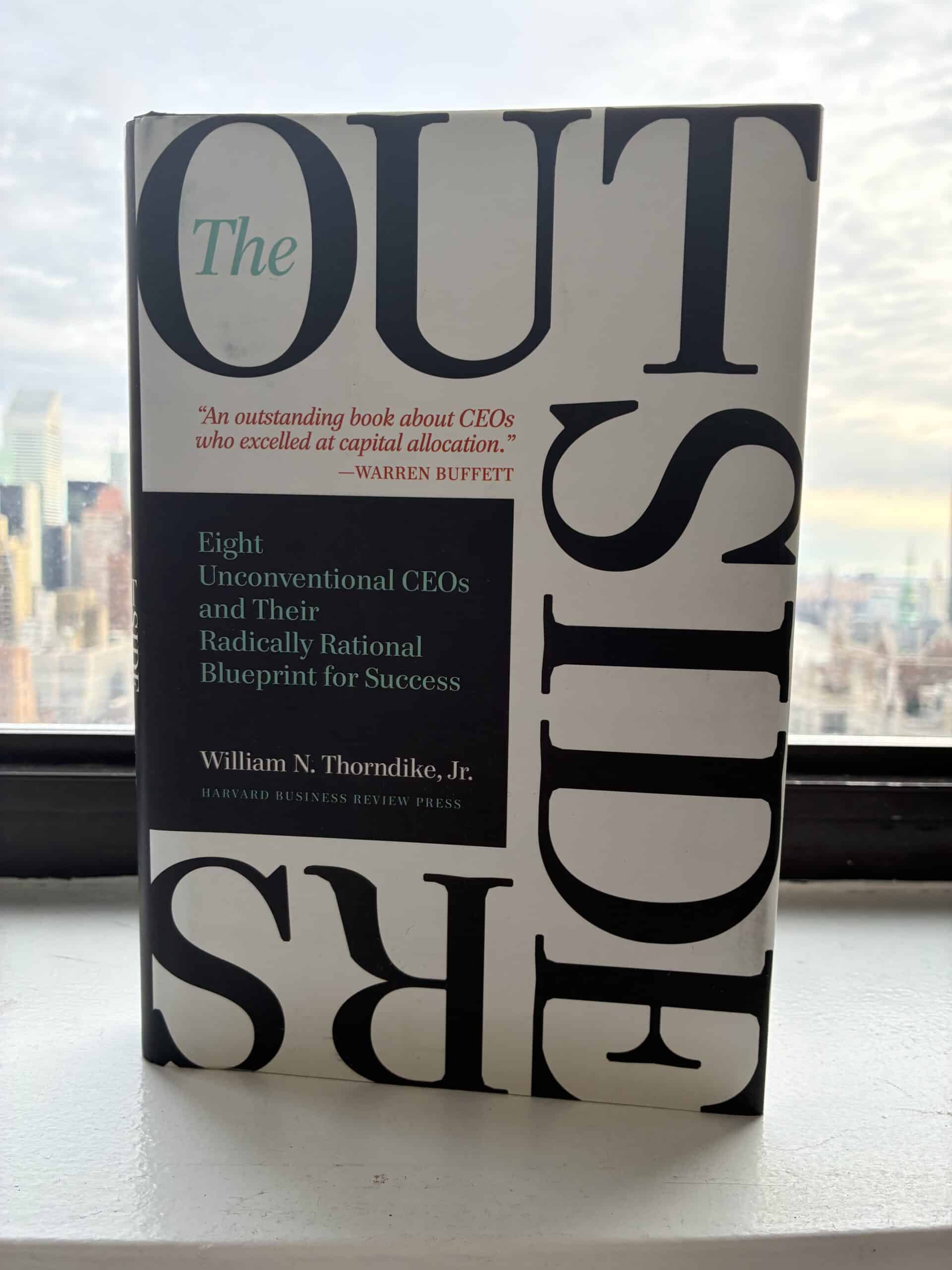
Eight unconventional CEOs who massively outperformed the market — not through operational brilliance, but through capital allocation decisions that most investors never focus on. The honest reckoning with what actually drives long-term shareholder value.
ℹ Disclosure: This post contains Amazon affiliate links. If you buy through them, we earn a small commission at no extra cost to you. We only link to books we’ve read and recommend.
The CEOs who generated the most shareholder value over the last half century were not the most famous, the most operationally brilliant, or the most charismatic. They were the most disciplined capital allocators — obsessed with per-share value, indifferent to consensus, and willing to buy back stock aggressively, avoid dividends, and pass on acquisitions when the math didn’t work. Capital allocation is the CEO’s most important job. Most never learn it.
Overall rating
7.6/10
The book that completes the stock-picking trilogy with an honest reckoning: exceptional returns require decisions that most retail investors cannot replicate. Essential reading for understanding what actually creates shareholder value.
CEOs have one job that matters more than all the others. Almost none of them know it.
Thorndike’s methodology: he screened for CEOs who had led their companies for at least a decade and generated returns that massively outperformed both the S&P 500 and their industry peers. The eight he selected each outperformed the market by at least 7x over their tenure. The common thread was not their industry, their strategy, or their personality. It was their approach to capital allocation.
Most business books focus on strategy, leadership, and operational excellence. The Outsiders is about something different: the five decisions through which a CEO actually allocates the capital generated by the business — and why getting those decisions right over a long period produces results that operational excellence alone cannot approach.
The five capital allocation tools are straightforward: reinvesting in the existing business, acquiring other companies, paying dividends, paying down debt, or repurchasing shares. Every CEO makes these decisions constantly. Thorndike’s insight is that the conventional approach to these decisions — paying regular dividends, making acquisitions at a premium, avoiding buybacks as somehow self-serving — is almost exactly wrong. The CEOs who generated the most shareholder value did the opposite: they rarely paid dividends, were deeply skeptical of acquisitions, and bought back stock aggressively when it traded below their private-market value estimate.
The book’s most important and uncomfortable conclusion is that the CEOs who generated extraordinary returns did so through decisions that are structurally difficult for retail investors to evaluate in real time — and nearly impossible to replicate. Understanding what those decisions look like is valuable. Believing you can identify the next Singleton or Malone from a 10-K is a different claim.
Who they were, what they built, and by how much they outperformed
Thorndike’s eight subjects span industries and decades, but they share a common framework for thinking about capital that transcends any particular business context.
What the outsider CEOs shared — and what made them genuinely unconventional
Henry Singleton of Teledyne is the most extreme case in the book. Over a 12-year period, Singleton repurchased approximately 90% of Teledyne’s outstanding shares — reducing the share count from 88 million to under 12 million. This is not a rounding error. It is a total rethinking of what a company’s relationship with its shareholders should look like.
They thought in per-share value, not total value
The conventional CEO metric is total company value: revenue, market capitalization, earnings. The outsider CEOs thought almost exclusively in per-share value — what each share of the company was worth to its owner. A company whose total value grows by 10% while issuing shares at 15% is destroying shareholder value. A company whose total value stays flat while buying back 20% of shares is creating it. This distinction is so fundamental it seems obvious. It is almost never how publicly traded companies actually behave.
They were deeply skeptical of acquisitions
Academic research consistently shows that acquisitions destroy shareholder value on average. The acquirer pays a premium, assumes integration costs, and faces the difficulty of retaining talent in the acquired company. The outsider CEOs understood this intuitively and demanded a margin of safety on acquisitions that most dealmakers would find extreme.
Most acquisitions fail to create value for the acquirer’s shareholders. The outsider CEOs knew this and behaved accordingly: they set high hurdle rates, walked away from deals that didn’t meet them, and preferred to buy back their own stock — where they knew the business, understood the value, and faced no integration risk — when that math worked better than any available acquisition. When they did acquire, they were disciplined about price in ways that acquisition-hungry CEOs rarely are.
They were indifferent to Wall Street’s opinion
The outsider CEOs did not manage for quarterly earnings. They communicated infrequently with analysts. They did not manage to consensus estimates. Tom Murphy of Capital Cities famously told analysts as little as legally required and focused entirely on what he believed would create long-term per-share value. This independence from short-term market opinion is what allowed them to make the decisions — particularly aggressive buybacks during price declines — that look obvious in retrospect and are psychologically nearly impossible in practice.
They decentralized operations and centralized capital allocation
Every outsider CEO ran a highly decentralized organization — business unit managers had extensive operational autonomy. What was centralized was capital: all significant capital allocation decisions went through the CEO. This structure reflects an important distinction: operational excellence is a talent that can be distributed across an organization. Capital allocation is a judgment that is best concentrated in the person with the most complete picture of the whole business and the most direct accountability to shareholders.
Does your company have an outsider CEO?
The checklist below is designed to be applied to a specific company you own or are considering. It is not a screen for a database — it requires reading through earnings calls, 10-Ks, and proxy statements. The point is not a mechanical score but the quality of thinking the questions force about capital allocation discipline.
Thorndike’s framework is most useful as a lens for evaluating management quality in companies you already research. The questions below distill the behavioral patterns he documented across all eight outsider CEOs. Apply them to a company you own or are considering — the answers will tell you more about long-term value creation potential than most financial metrics do.
Based on Thorndike’s eight outsider CEOs. Check each criterion that applies to the management team you’re evaluating.
What the book gets exactly right — and the uncomfortable conclusion it reaches
Thorndike is admirably honest about the selection bias problem. He chose his eight subjects because they were extraordinary outliers. The question he doesn’t fully answer is what the full distribution of CEOs who behaved like outsiders looked like — some of whom presumably generated mediocre results using the same framework, without getting a book written about them.
The capital allocation framework is genuinely correct
The core analytical contribution of The Outsiders is unimpeachable: capital allocation is the CEO’s most important job, most CEOs do it poorly by conventional standards, and the ones who do it well generate dramatically better long-term returns. This is not controversial in financial economics and Thorndike documents it compellingly. The framework for evaluating capital allocation quality — does management think in per-share value? are they disciplined about acquisitions? do they buy back stock when it’s cheap? — is directly applicable and genuinely useful.
The honest reckoning: you probably cannot replicate this
The book’s most important and least comfortable implication is that the decisions Thorndike describes — the willingness to repurchase 90% of shares, to pass on every acquisition for years, to communicate minimally with Wall Street — require a combination of board support, institutional autonomy, and long-term conviction that is structurally unavailable to most public company CEOs operating today. Thorndike’s outsiders mostly operated before quarterly earnings guidance became the norm, before activist investors became ubiquitous, and before the social media cycle demanded constant CEO communication. The environment that allowed these behaviors is substantially different from the environment facing CEOs today.
Selection bias — the book is about the best outcomes
The eight CEOs Thorndike profiles were selected precisely because their outcomes were extraordinary. There is no way to know how many CEOs applied similar frameworks and generated ordinary or poor results. The book is not a controlled experiment — it is a study of the best-case outcomes from a particular approach to capital allocation. The conclusions are directionally correct but should not be treated as a reliable predictor of results for any individual company.
The Wealth Shelf take on reading this book
Read it as a framework for evaluating management quality, not as a stock-picking methodology. The CEO Quality Checklist above is the most direct application: use it when evaluating any company you’re researching to assess whether management thinks about capital allocation the way Thorndike’s outsiders did. The book is also the most honest conclusion to the stock-picking trilogy — Lynch makes the best case for individual investors, Mayer extends it to modern compounders, and Thorndike provides the honest accounting of what actually drives exceptional returns over the long term.
Three things the book makes immediately actionable
1. Evaluate the CEOs of every company you own against Thorndike’s framework
The most revealing source for evaluating CEO capital allocation quality is not the 10-K — it is the earnings call transcripts and the shareholder letters over multiple years. What does management say about buybacks when the stock is down? How do they talk about acquisitions? Do they mention per-share value or total market capitalization? The language reflects the framework.
Apply the checklist above to every significant position in your portfolio. Read the last three years of earnings call transcripts and ask: does this CEO think in per-share value or total company value? Have they been disciplined about acquisitions — or do they consistently pay premiums for growth? Do they buy back stock when it’s cheap — or only when it’s at all-time highs? The answers will not tell you whether to hold or sell, but they will tell you something important about the quality of stewardship over your capital.
2. Treat buyback behavior as a signal, not just a return mechanism
Thorndike’s outsiders used buybacks as a capital allocation tool — buying aggressively when their private-market value estimate significantly exceeded the stock price, and stopping when the gap closed. Most companies buy back stock continuously regardless of valuation, treating it as a default use of excess cash rather than a disciplined valuation-driven decision. Track the relationship between when a company buys back stock and where the stock trades relative to earnings. Companies that buy back the most stock at the highest prices are returning capital less efficiently than the headline buyback number suggests.
3. Apply skepticism to acquisition announcements proportionally to premium paid
The academic and empirical evidence on acquisitions is consistent: they destroy acquirer shareholder value on average. When a company you own announces an acquisition, the relevant question is not whether the target is a good business but whether the price reflects a margin of safety. Acquisitions at significant premiums to intrinsic value are a form of capital destruction even when the acquired business is excellent. Thorndike’s outsiders understood this. Most currently operating public company CEOs, who are rewarded for empire-building and growth at any price, have not internalized it.
Where to go after The Outsiders
The honest conclusion to the stock-picking trilogy. Essential reading — with clear eyes about what it can and cannot teach you.
The Outsiders earns its place as the most important book on capital allocation written for a general investing audience. Thorndike’s framework — think in per-share value, be skeptical of acquisitions, buy back stock when it’s cheap, decentralize operations — is correct, well-evidenced, and directly applicable to evaluating the quality of any management team.
Its honest limitation is the gap between understanding the framework and being able to identify in advance which CEOs will apply it with the consistency and conviction that Thorndike’s eight subjects did. The book provides the lens. It cannot provide the certainty. For investors committed to passive strategies, it clarifies why. For investors doing fundamental analysis of individual companies, it is indispensable.
Read next in the library: The Intelligent Investor — Thorndike’s capital allocation framework is the operational expression of Graham’s margin of safety principle applied at the management level. Graham explains why price versus value is the fundamental question; Thorndike explains how exceptional CEOs answer it with the capital under their control. →
Buy The Outsiders on Amazon →