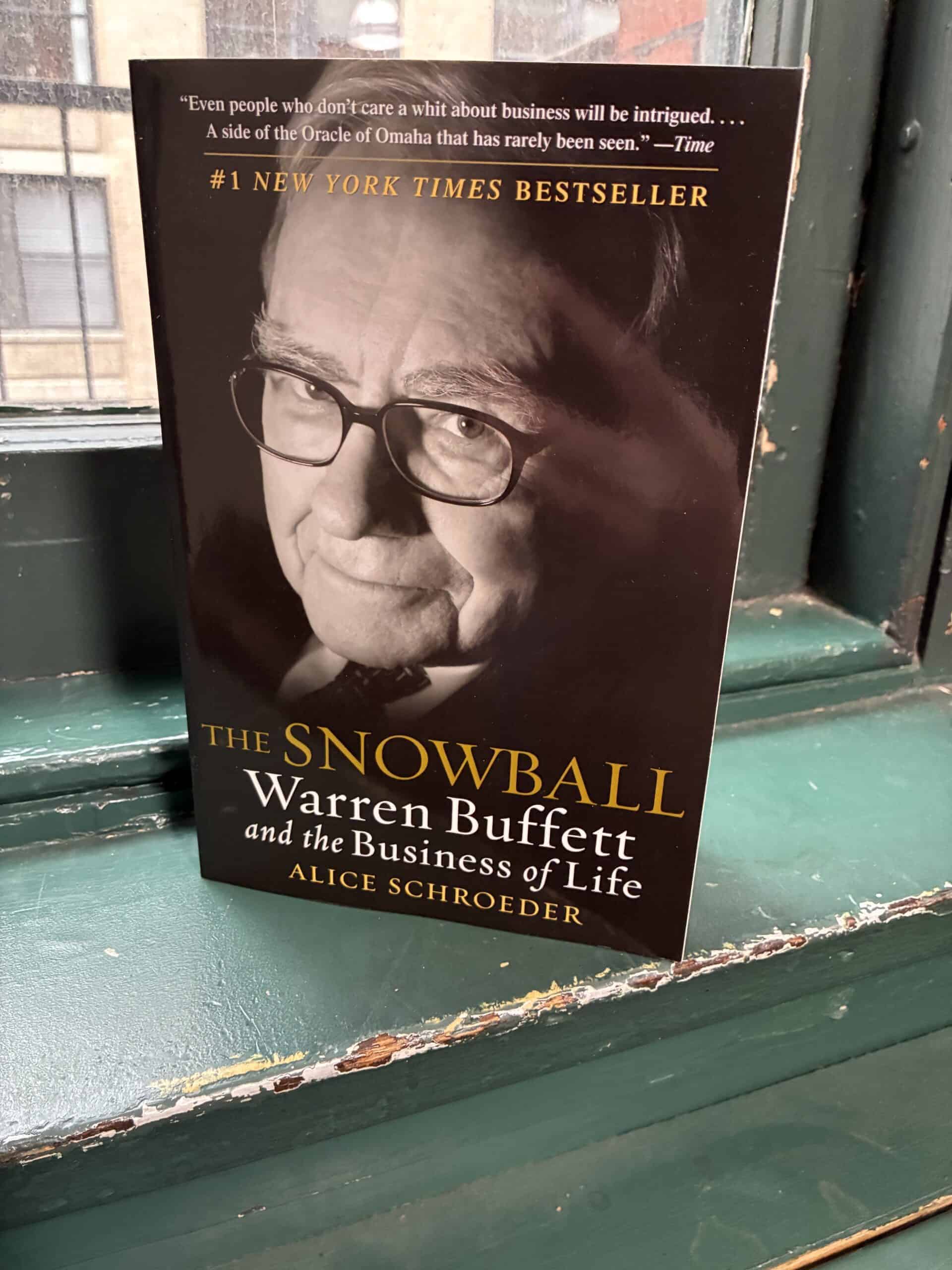
The Snowball
Alice Schroeder · Book Summary
The only biography Buffett authorized and then regretted. 960 pages that reveal not how to invest like Buffett, but how he actually lived — what he prioritized, what he sacrificed, and what the compounding life looks like in full.
ℹ Disclosure: This post contains Amazon affiliate links. If you buy through them, we earn a small commission at no extra cost to you. We only link to books we’ve read and recommend.
Life is like a snowball. You need wet snow and a really long hill. Buffett found both early — a high-return activity and an extraordinarily long runway. The book reveals something most investing texts miss: the strategy is almost secondary. What actually matters is starting early, staying consistent, never stopping, and living in a way that lets the compounding continue for decades.
Overall rating
7.0/10
Extraordinary access, revelatory on the behavioral side, and genuinely too long. The first 400 pages earn a 9. The last 560 earn a 6. Read it for the life, not the investment tactics.
Not an investing manual. A portrait of what the compounding life looks like from the inside.
Buffett granted Schroeder unprecedented access — hundreds of hours of interviews, access to his personal files, and interviews with family members and business partners he had never allowed on the record before. He later expressed ambivalence about the candor he permitted. The intimacy of the portrait is both the book’s greatest strength and the source of some of the discomfort it produces.
The Snowball is not a book about how to invest. Readers who come to it looking for portfolio construction advice, stock-picking frameworks, or a replication of Buffett’s methods will find those things — but buried inside 960 pages that are fundamentally about something else: how an extraordinary mind actually operates across a full human life, with all the complexity, contradiction, and cost that entails.
Alice Schroeder spent years with Buffett producing what remains the most complete and most honest portrait of him ever written. It covers his childhood obsessions with numbers and money, his early partnership years, the building of Berkshire, the personal relationships he maintained and neglected, and the philosophical framework — the snowball metaphor — that he uses to understand his own life. The investment methods are present throughout, but they are context rather than subject.
What makes The Snowball valuable for serious investors is not the tactics but the behavioral and psychological portrait. Reading 960 pages about how Buffett actually lived — what he read, how he spent his time, what he worried about, what he refused to do — reveals something that no framework book captures: the compounding life is a total orientation, not a set of decisions applied to a portfolio.
The number that changes how you think about starting early
Buffett started investing at 11. He has said he feels like he “wasted” the first ten years of his life by not starting at 1. This is obviously hyperbolic — but the underlying point is serious. His 75-year investing runway is not a footnote to his returns. It is the primary explanation for them.
The most important single fact in The Snowball is one that Housel also cites in The Psychology of Money: approximately 97% of Warren Buffett’s net worth was accumulated after his 65th birthday. Not because his returns improved with age — they didn’t — but because compounding is a function of time, and 75 years of compounding produces outcomes that 30 or 40 years cannot approach regardless of the annual return rate.
How a 75-year runway produces outcomes no shorter period can replicate.
97% of Buffett’s wealth was accumulated after age 65. His annual returns across his career averaged roughly 20% — exceptional, but achievable by talented investors. His 75-year runway is what made those returns produce a number that has no precedent. The lesson is not the return rate. It is the duration.
The behavioral portrait behind the investment record
One of the book’s most memorable details: Buffett ate the same breakfast every morning — either a sausage McMuffin or a bacon, egg, and cheese biscuit from McDonald’s, priced at $3.17. He has described the ritual as minimizing decision fatigue. Every routine that removes a trivial decision frees cognitive resources for the decisions that actually matter.
He read obsessively and almost nothing else
Buffett is estimated to spend 80% of his working day reading — annual reports, trade journals, newspapers, biographies. Schroeder’s portrait makes clear this was not a habit he developed as a successful investor. It was the characteristic that made him one. From childhood, his default response to any problem was to find a book about it. The investment methodology is downstream of a decades-long information intake that most investors never attempt.
He was ruthless about protecting his attention
Buffett has famously said that the difference between successful people and very successful people is that very successful people say no to almost everything. The Snowball documents what this looks like in practice: a life deliberately stripped of commitments, meetings, and activities that don’t compound toward what he actually cares about.
The book documents a recurring pattern: Buffett consistently declined opportunities — board positions, social obligations, business ventures outside his circle of competence — that would have been valuable to almost anyone else. The refusals were not arrogance. They were a systematic protection of the resource he recognized as finite and irreplaceable: his time and attention. The compounding life requires compound interest on attention as much as on capital.
He never sold during crashes
Across multiple market crashes — 1973–74, 1987, the dot-com collapse, 2008 — Buffett not only held his positions but used the dislocations to add to them. Schroeder’s portrait shows that this wasn’t stoic discipline in the face of fear. It was the result of a framework so deeply internalized that market declines genuinely registered to him as opportunities rather than threats. The behavioral edge wasn’t performance under pressure. It was the absence of the emotional response that creates pressure in the first place.
The personal cost the book doesn’t flinch from
The Snowball is unusual among business biographies in its willingness to document what the compounding life cost — the relationships that suffered from neglect, the emotional unavailability that Schroeder records without editorial comment, the gap between the warm public persona and the more complicated private one. The book doesn’t moralize about this. But it doesn’t sanitize it either. Anyone reading it as a blueprint for life should read those sections as carefully as the investment chapters.
Are you building a compounding life — or just a portfolio?
Buffett’s compounding life is not primarily about investment decisions. It is about the total configuration of how he spends his time, protects his attention, manages his learning, and maintains the emotional equilibrium that allows long-term thinking to override short-term instincts. The audit below examines these dimensions, not the portfolio.
The Snowball’s most valuable lesson is not about picking stocks. It’s about the conditions that allow compounding to work across decades: consistent habits, protected attention, continuous learning, and the emotional constitution to stay the course. Rate yourself honestly on each dimension below — then see how your current life configuration compares to the pattern Schroeder documented across Buffett’s career.
Rate yourself 1–5 on each dimension. 1 = not at all like me. 5 = this describes me precisely. Be honest — the point is the reflection, not the score.
960 pages is 400 pages too many — and the access is worth every one of them
The book’s length is its most frequently cited flaw and its most misunderstood one. The first half — childhood through the early partnership years — earns every page. The second half, covering the Berkshire decades, is where the detail-to-insight ratio deteriorates. Most readers would be well-served by reading the first 400 pages carefully and skimming the rest.
The length is a genuine problem
At 960 pages, The Snowball is nearly twice as long as it needs to be. The detail that makes the early chapters revelatory — the specificity of Schroeder’s reporting on Buffett’s childhood, his early partnerships, his relationship with Munger — becomes exhausting when applied to the Berkshire decades, where many chapters cover events that are already well-documented elsewhere. The book would be substantially better at 600 pages. It isn’t, and that is a real cost for most readers.
The investment tactics are not the book’s contribution
Readers seeking an explanation of Buffett’s investment methods will find them in the book — but they will find better explanations in Warren Buffett’s Ground Rules, Poor Charlie’s Almanack, and The Intelligent Investor. The Snowball’s unique contribution is the biographical and psychological portrait, not the investment framework. If you’ve already read those books, The Snowball fills in what they leave out. If you haven’t, start there.
The personal sections are the most original material
Schroeder’s willingness to report on the personal dimensions of Buffett’s life — his marriages, his relationships with his children, the tension between his public generosity and his private patterns — is what makes the book genuinely different from any other Buffett text. These sections are sometimes uncomfortable. They are also the most honest and the most instructive, because they show what the single-minded pursuit of compounding actually requires of a person, and what it tends to crowd out.
The Wealth Shelf take on reading this book
Read the first 400 pages carefully, then skim strategically. The childhood and early partnership chapters are among the most revealing things written about how an investment mind actually develops. The Berkshire decades add detail without proportional insight. If you’re short on time, read those chapters and Schroeder’s epilogue — which is one of the most honest assessments of the compounding life ever written about anyone.
Three things the book makes immediately actionable
1. Calculate how many years your own snowball has to roll
The most practical implication of Buffett’s timeline is the cost of delay — not just in returns foregone, but in runway shortened. A 35-year-old starting today has roughly 30 years of compounding ahead before a typical retirement. A 25-year-old has 40. That additional decade, at 7% real returns, roughly doubles the terminal value of the same monthly contribution.
The most important number is not your current net worth or your annual return. It is the number of years between now and the point at which you stop adding to and start drawing from your investments. Every year that number is extended — by starting earlier, by finding ways to extend your earning years, by reducing the size of your required annual withdrawals — is worth more than any improvement to your investment strategy. Start now. The hill matters as much as the snow.
2. Audit what you are actually compounding
Buffett compounded capital, knowledge, and relationships simultaneously. He read voraciously every day for 75 years. He built a network of trust with business partners he never had to replace. He developed mental models that compounded in value as each new situation added to them. Ask yourself honestly: in the areas of your life beyond your investment portfolio, what are you systematically compounding? Scattered effort produces linear results. Consistent, focused effort in one or two areas produces exponential ones.
3. Protect your attention as a financial asset
The Snowball’s most practically underappreciated lesson is about attention management. Buffett’s extraordinary returns required extraordinary focus — not just during market hours, but as a total life orientation. The decisions you make about how you spend your time and attention are investment decisions with compounding consequences. Every commitment that doesn’t compound toward what you actually care about is a cost. The question Schroeder’s portrait implicitly asks is: what are you saying yes to that is preventing you from saying yes to the thing that actually matters?
Where to go after The Snowball
The most honest portrait of what the compounding life actually costs — and produces.
The Snowball earns its 7.0 on the strength of its first half and its biographical honesty, and loses points for a second half that tests the patience of all but the most dedicated readers. It is not the right book to learn Buffett’s investment methods — there are better texts for that. It is the right book to understand the total configuration of a life organized around compounding, with clear eyes about what that configuration requires and what it tends to sacrifice.
Read it for the psychology, not the tactics. Read the first 400 pages carefully and the rest selectively. And read the epilogue regardless — it is one of the most honest assessments of extraordinary financial success that exists anywhere in print.
Read next in the library: The Psychology of Money — Housel distills the compounding insight from Buffett’s biography into its most applicable form. The chapter on compounding in The Psychology of Money is the 30-page version of the most important thing The Snowball’s 960 pages demonstrate. →
Buy The Snowball on Amazon →