Poor Charlie’s Almanack
Charlie Munger · Book Summary
Warren Buffett’s partner for 60 years built one of history’s great investment records with one unconventional tool: a latticework of mental models borrowed from every discipline worth knowing.
ℹ Disclosure: This post contains Amazon affiliate links. If you buy through them, we earn a small commission at no extra cost to you. We only link to books we’ve read and recommend.
Most people think with one mental tool and apply it everywhere. Munger thinks with a hundred. The latticework — models borrowed from psychology, economics, physics, biology, history — is not a system for finding answers. It is a system for asking better questions. Invert, always invert. The clearest path to success is often the ruthless elimination of the causes of failure.
Overall rating
8.2/10
One of the most distinctive thinking frameworks in the library. Dense, non-linear, and worth every hour it demands.
How you think matters more than what you think about
Munger was 81 when the Almanack was first published. He continued working, thinking, and investing until his death in November 2023 at age 99. His last public talk was in 2023. The compounding of knowledge works exactly the way he describes.
Charlie Munger spent sixty years as Warren Buffett’s partner at Berkshire Hathaway. Together they built one of the most extraordinary capital allocation records in history. Munger’s contribution was not primarily financial analysis — it was a framework for thinking that he developed over decades of reading across every discipline he considered worth understanding.
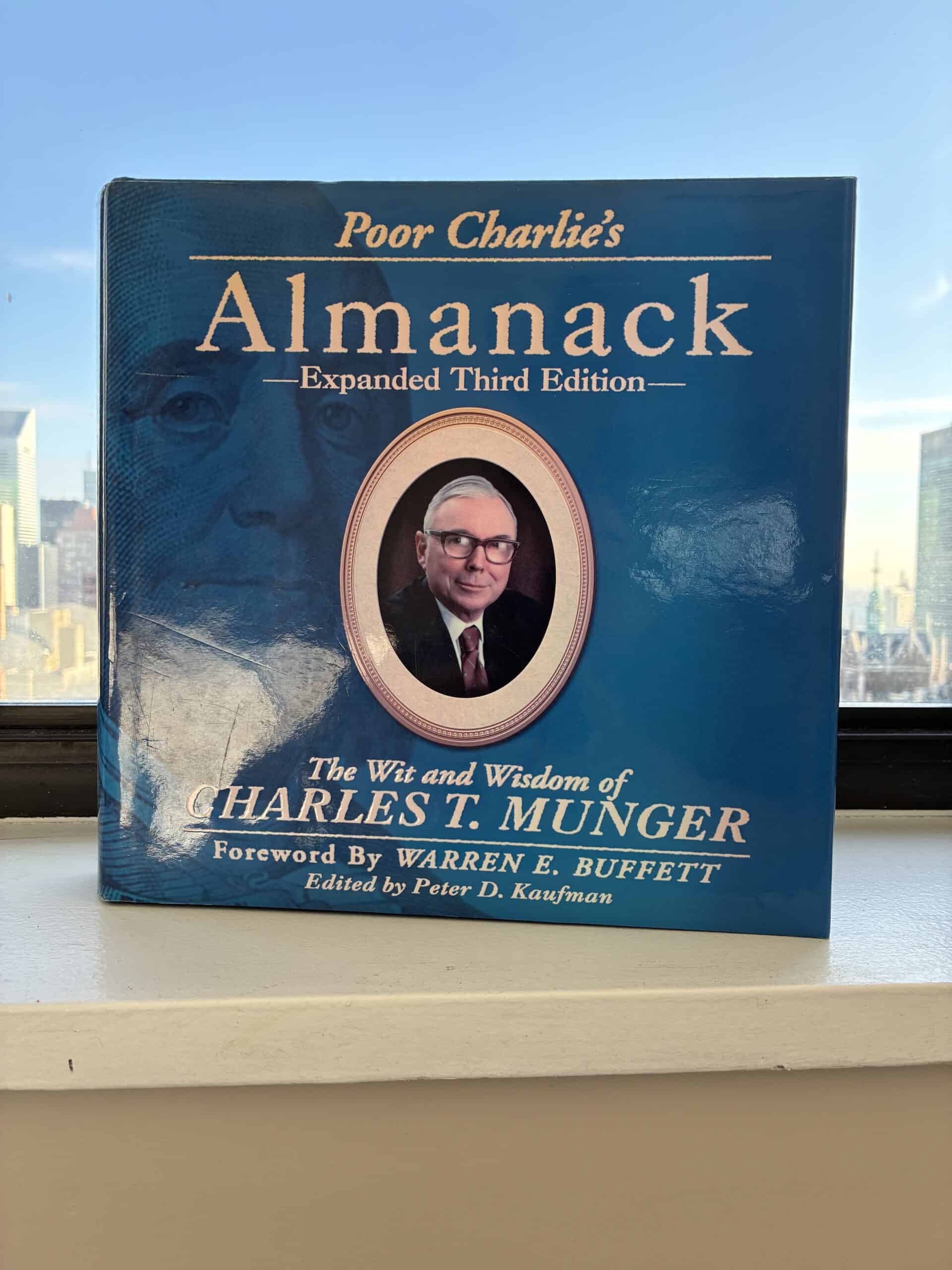
Poor Charlie’s Almanack, edited by Peter Kaufman and first published in 2005, is a collection of Munger’s speeches, essays, and talks assembled into something approaching a coherent philosophy. It is not a book Munger wrote in a traditional sense — it is a portrait of how an exceptional mind approaches problems, decisions, and the accumulation of wisdom over a very long life.
The central argument is unusual in a field full of systems and frameworks: that the right way to think is more important than any specific thing you might think about. A latticework of mental models — borrowed from psychology, economics, mathematics, physics, biology, and history — produces better decisions than deep expertise in any single domain. Munger’s prescription is not to become a better analyst. It is to become a more broadly educated thinker.
The most practically useful models from Munger’s latticework
Munger claims to have identified approximately 100 mental models worth having in your latticework. The six below are the ones most directly applicable to investing and financial decision-making. They also happen to be the ones he discusses most frequently.
Munger’s full latticework contains models from every discipline he considers worth studying. What follows is not a complete catalogue — it is the six models that appear most consistently in his financial thinking and that have the most direct application to how individuals manage money and make investment decisions.
Always invert
Munger attributes the inversion principle to the mathematician Carl Jacobi, who said ‘man muss immer umkehren’ — one must always invert. Munger applied it to everything from investment decisions to life advice.
Of all the models in Munger’s latticework, inversion is the one he returns to most consistently and the one with the most immediate practical application. The principle is simple: when you want to achieve a goal, instead of asking how to achieve it, ask what would guarantee you fail to achieve it — and then avoid those things.
Applied to investing: rather than asking how to generate exceptional returns, ask what behaviors reliably produce poor investment outcomes. The answer is well-documented: high fees, frequent trading, investing in things you don’t understand, selling during downturns, following tips, concentrating in single positions, and confusing volatility with permanent loss. Eliminating these behaviors does not guarantee exceptional returns — but it removes the main obstacles to adequate ones.
Inversion applied to personal finance
Instead of asking “how do I build wealth?” ask “what guarantees I won’t build wealth?” The answers: spending more than I earn. Carrying high-interest debt. Paying high fees on investments. Starting too late. Selling investments during market downturns. Failing to insure against catastrophic risks. Letting lifestyle inflate with every income increase. Eliminate these and the path to wealth becomes considerably clearer.
Apply the models — not just understand them
Munger is explicit that knowing the names of mental models is worthless. The models only become useful when they change how you automatically perceive situations — when you reach for them instinctively rather than mechanically.
Munger’s models are thinking tools, not trivia. The test of whether you have actually internalized a model is whether you reach for it automatically when a situation calls for it — not whether you can recite its definition. The exercise below presents eight real financial scenarios. For each one, identify which model Munger would apply first.
What the book delivers and what it cannot
The Almanack’s biggest weakness is structural. It was assembled by an editor from speeches and talks, not written as a cohesive argument. Some models appear multiple times in slightly different form. The reader has to do organizational work that a conventional book would do for them.
The format is a genuine obstacle
Poor Charlie’s Almanack is not a book in the conventional sense. It is a curated collection of speeches, essays, commencement addresses, and transcribed talks, assembled by Peter Kaufman with Munger’s cooperation. The result is non-linear, occasionally repetitive, and assumes a breadth of general knowledge that many readers will not have. The book rewards the kind of reader who already reads widely. For readers who do not, it is demanding in ways that can feel unrewarding before the framework clicks into place.
Munger’s investment advice — buy wonderful businesses at fair prices, hold forever — is correct in principle. It is also largely inapplicable to retail investors who do not have Berkshire’s deal flow, management access, or ability to take controlling positions.
The investing advice is harder to apply than it appears
Munger’s investment framework — find wonderful businesses with durable competitive advantages, buy them at fair prices, hold them forever, and never sell — is one of the most cited approaches in investing. It is also one of the most difficult to apply well. Identifying a truly wonderful business requires analytical skills and information access that most retail investors do not have. The principle is correct. The implementation requires either significant expertise or the humility to admit that index funds are the honest application of Munger’s own logic for most people.
What the book does that nothing else does
No other book in the library teaches you how to think about thinking. That is Munger’s unique contribution — a meta-level framework for approaching problems that makes every other mental model more useful. The latticework concept, the emphasis on inversion, the ruthless examination of incentive structures — these are not investing strategies. They are cognitive tools that improve every decision you make, financial and otherwise. That is a rarer thing than a good investment framework.
The Wealth Shelf take on reading this book
Read it slowly and non-linearly. Start with the speeches on human misjudgment — they are the clearest expression of the mental models and the most immediately applicable. Do not expect a system or a step-by-step framework. Expect a portrait of how an exceptional mind approaches the world. The value compounds over time in a way that most books do not. Revisit it in five years and you will find different things in it than you find today.
Three things the book makes immediately actionable
1. Apply inversion to your current financial situation
Take your most important financial goal — building an emergency fund, paying off debt, reaching a savings target — and invert it. Ask what would guarantee you fail to reach it. Write the list down. The behaviors and circumstances on that list are your actual obstacles, more clearly defined than any positive plan would produce. Address them first.
2. Audit your incentive structures
Munger’s incentive bias check: for any financial relationship or product, ask who gets paid when and how. The answer tells you more about what you should expect than any amount of due diligence on the product itself.
Apply Munger’s incentive lens to every financial relationship you currently have. Your investment platform, your advisor if you have one, the funds you own, the insurance products you hold. For each one, ask: how does this person or institution make money? Is that incentive aligned with my interests or opposed to them? The exercise will surface at least one misalignment you have not previously examined.
3. Pick one mental model and apply it for 30 days
Munger’s models become useful through practice, not reading. Choose one — inversion is the highest-leverage starting point — and apply it to every significant decision you make for the next 30 days. Before any financial decision, ask what would guarantee a bad outcome and whether you are doing any of those things. The habit of inversion, once established, changes how you approach problems permanently.
Where to go after Poor Charlie’s Almanack
The most important book in the library that is hardest to read and slowest to pay off.
Poor Charlie’s Almanack does not deliver a system, a framework, or a set of actionable steps in the way most books in this library do. What it delivers is something rarer and more durable: a model for how to think. The mental models compound in usefulness over years in the same way that money compounds over time.
The accessibility score of 5 is honest — this is a demanding book that rewards the reader who comes to it with patience and broad intellectual curiosity. It is not the first book to read in this library. It may be the most important book to return to once you have read the others.
Read next in the library: The Intelligent Investor — Graham provides the rigorous value investing foundation that Munger’s mental models sit on top of. The two books together are more powerful than either alone. →
Buy Poor Charlie’s Almanack on Amazon →